Summary
Andy Burnham is a prominent British politician and the current Mayor of Greater Manchester, known for his influential role in regional devolution and economic regeneration amid the United Kingdom’s broader political and economic transition. With a political career spanning over two decades, including ministerial positions under Prime Minister Gordon Brown and a long tenure as a Labour Member of Parliament, Burnham has established himself as a leading voice advocating for greater local control and tackling entrenched regional inequalities, particularly between London and northern England. His leadership of Greater Manchester exemplifies “Manchesterism,” a model promoting integrated transport, housing, and economic development through devolved powers and collaborative governance.
Burnham’s tenure as mayor has been marked by ambitious investment strategies such as the £1 billion Good Growth Fund and the creation of the Bee Network, an integrated public transport system aimed at reducing congestion and boosting connectivity across Greater Manchester. His economic vision focuses on reindustrialization, innovation clusters like the Atom Valley manufacturing hub, and sustainable growth supported by partnerships with institutions like the Greater Manchester Pension Fund. These initiatives have contributed to Greater Manchester becoming the fastest-growing UK city region economy over the past decade, reinforcing Burnham’s reputation as a pragmatic and business-friendly socialist committed to inclusive regional development.
Despite widespread acclaim at the regional level, Burnham’s political approach has generated debate and scrutiny. Critics question the scalability of his regional governance model to national policy and highlight tensions within the Labour Party regarding his positioning between the party’s left wing and more moderate factions. His evolving stance on immigration, supporting tighter controls such as the “Visa Brake,” has sparked discussion over the balance between enforcement and Labour’s traditional liberal values. Furthermore, Burnham’s potential candidacy for Labour leadership has elicited mixed reactions from markets and political commentators concerned about fiscal policies and party unity.
Overall, Andy Burnham’s career embodies the complexities of navigating regional empowerment in a highly centralized UK political system. His efforts to address economic disparities through devolved investment and policy innovation have made him a notable figure in contemporary British politics, particularly as the UK undergoes significant structural and economic changes. While his regional successes are clear, questions remain about his future influence on national governance and the broader direction of the Labour Party.
Early Life and Education
Andy Burnham described himself as “Catholic by upbringing” though he is “not particularly religious,” emphasizing that Catholic social teaching has significantly influenced his political views. He reflected on his school days, noting that reading the catechism was a powerful and formative experience. After completing his university education, Burnham moved to London, where he began his career working in the trade press before entering politics.
Political Career
Andy Burnham began his political journey at an early age, joining the Labour Party at 15. His official entry into mainstream politics was marked by his election as Member of Parliament (MP) for Leigh in 2001, a seat he held while rapidly ascending through the party ranks under the leaderships of Tony Blair and Gordon Brown. Early in his career, Burnham worked as a researcher for MP Tessa Jowell and served as a special adviser to Culture Secretary Chris Smith before becoming an MP.
During his parliamentary tenure, Burnham held several significant cabinet roles, including positions in the Home Office, the Department of Health, the Treasury, and the Department for Culture. His ministerial career culminated as Secretary of State for Health from 2009 to 2010 under Gordon Brown. Throughout his 16 years in Parliament, he focused heavily on addressing regional inequalities and championed causes such as the Hillsborough disaster, reflecting his commitment to regional justice and fairness. Burnham identifies politically as a socialist aligned with the soft left faction of the Labour Party.
In 2017, Burnham transitioned to regional leadership, becoming the directly elected Mayor of Greater Manchester. This role came as part of the English devolution process, transferring significant powers from the national government to the Greater Manchester Combined Authority (GMCA) to enable localized decision-making on key issues such as transport, health, housing, and policing. As mayor, Burnham chairs the GMCA and holds the powers of the Greater Manchester Police and Crime Commissioner, overseeing strategic governance for the region.
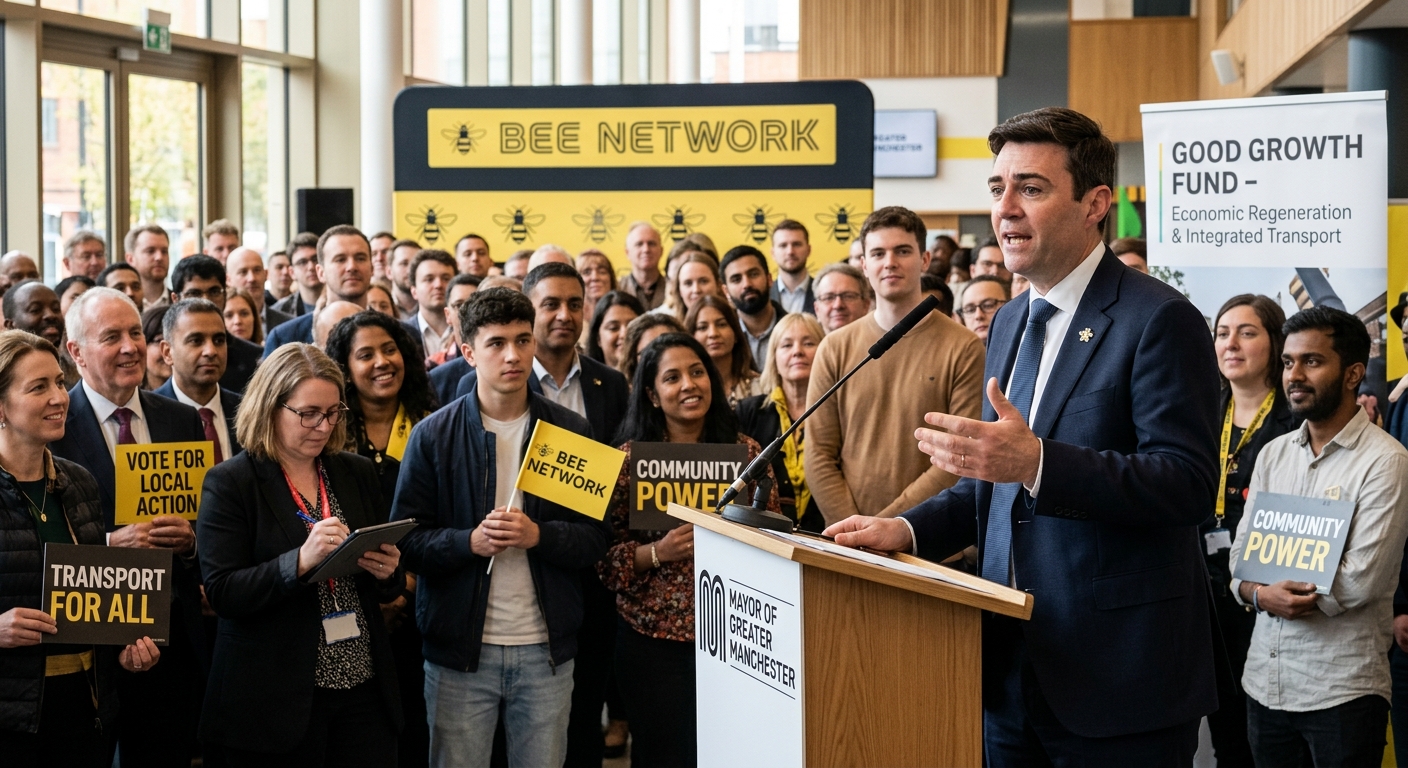
Burnham’s mayoralty has been marked by ambitious initiatives aimed at fostering economic growth and improving public services in Greater Manchester. Notable projects include the launch of the Bee Network in 2023, an integrated transport system uniting bus, tram, bicycle, and train travel, designed to tackle congestion and enhance connectivity. He also introduced the Good Growth Fund, a £1 billion investment targeting regeneration projects across the region’s boroughs, alongside a spatial plan featuring a 10-year pipeline of priority development projects to boost housing and job creation.
Advocating for greater fiscal devolution, Burnham has emphasized the importance of local control in reversing historical trends of centralization. He has linked contemporary economic challenges, such as the cost-of-living crisis, to legacy policies from the Thatcher era, including deregulation and privatisation that affected essential goods pricing and housing markets. His leadership style, sometimes described as embodying collaboration among government, businesses, trade unions, and community groups, reflects a pragmatic approach to partnership working within Greater Manchester.
Despite his strong focus on his mayoral role, Burnham remains a significant figure within the Labour Party. He has been recognized as a key dissenter and a crucial voice on the party’s left, with speculation about his potential future leadership. In 2023, he was ranked twelfth on the New Statesman’s Left Power List, highlighting his influence and stature within Labour politics.
Role in the UK Transition
Andy Burnham has positioned himself as a key figure in reshaping the United Kingdom’s political and economic landscape during the ongoing national transition. Central to his approach is addressing the entrenched regional inequalities that have long characterized the UK, particularly the economic disparity between London and other regions such as northern England. Burnham has criticized the government’s response to recent economic challenges for disproportionately favoring London and the South East while neglecting support for workers and businesses in the North, thereby exacerbating feelings of political and economic marginalization in these areas.
Burnham advocates for a significant decentralization of power from Westminster, opposing what he describes as the overcentralization initiated in the 1980s under Margaret Thatcher. He argues that local communities should gain greater control over key aspects of daily life, including housing, utilities, transport, and education. This vision aligns with his promotion of “Manchesterism,” exemplified by initiatives like Manchester’s integrated Bee Network, which has successfully encouraged a return to public transport by fostering more locally accountable governance.
In practice, Burnham supports devolving financial control to local authorities through mechanisms such as investment funds like the Good Growth Fund and the Integrated Settlement—a consolidated £630 million funding pot from national government combining over 20 streams related to transport, housing, regeneration, and employment support. These efforts aim to empower regions to directly influence and stimulate local growth and regeneration.
Additionally, Burnham has taken a pragmatic stance on immigration control amid the broader UK transition. He backs the continuation of recent tighter immigration policies introduced by the interior minister, including maintaining the “Visa Brake” initiated in March 2026, which restricts migration from certain nationalities to better manage migration flows.
Critics and analysts, however, remain cautious about the scalability of Burnham’s regional approach at the national level. For instance, Kallum Pickering, chief economist at Peel Hunt, has questioned whether Burnham’s regional governance model can be effectively translated into a comprehensive national policy framework. Furthermore, political commentators like Stephen Bush have noted that Burnham’s policy proposals as a prospective Labour Party leader appear more left-leaning than his actual record as a metro mayor, suggesting that institutional constraints might limit the implementation of his broader vision.
Investment Insights
Greater Manchester mayor Andy Burnham has spearheaded a transformative investment strategy aimed at accelerating economic growth and regeneration across the city region. Central to this approach is the £1 billion GM Good Growth Fund, designed to finance a pipeline of around 30 major projects that span every district, fostering both housing and employment development at pace and scale. The initial £400 million tranche is expected to deliver nearly 3,000 new homes, over 22,000 jobs, and two million square feet of new employment space, unlocking an additional £1.3 billion in private capital to catalyse further development across Greater Manchester.
A key focus of Burnham’s strategy is the creation of high-value industrial clusters, particularly the Atom Valley manufacturing mega-cluster. This initiative targets boroughs such as Rochdale, Oldham, and Bury, aiming to establish a globally competitive hub for advanced materials, sustainable manufacturing, and industrial digitalisation. The plan includes expanding innovation districts like Sister in Manchester city centre, which will feature new office and laboratory spaces supporting sectors including life sciences, digital technology, low carbon, and green industries. The strategy also integrates investments in infrastructure and affordable housing to ensure inclusive growth and regional balance, addressing concerns about past market funding gaps by reinvesting returns from profitable ventures into previously overlooked areas.
Burnham’s investment framework benefits from a unique partnership with the Greater Manchester Pension Fund, which contributes £300 million to the Good Growth Fund. This collaboration aims to align local investment with sustainable growth objectives and provide patient capital for long-term impact. Additionally, the fund’s revolving model—where loan repayments are reinvested into new projects—ensures a continuous pipeline of development and economic opportunity across the region.
The broader ambition of this approach is to reindustrialise Greater Manchester, building on its status as the fastest-growing UK city region economy over the past decade, with an annual growth rate of 3.1%—more than double the national average. Burnham’s vision encompasses not only economic expansion but also transport integration through the Bee Network, skills development programmes, and initiatives to boost affordable housing, all contributing to a more connected, skilled, and resilient local economy. These efforts collectively reinforce Greater Manchester as a compelling destination for investors seeking long-term growth opportunities amid the UK’s ongoing economic transition.
Public Perception, Criticism, and Political Challenges
Andy Burnham’s political career has been marked by both praise and criticism, reflecting the complexities of his regional and national approaches. A central theme in public perception concerns his advocacy for addressing regional inequalities in the UK. Burnham has argued that government policies have disproportionately favored London and the South East, neglecting the economic and social needs of northern England. This stance resonates with many in the North who feel that political power, investment, and opportunities are overly concentrated in the South, reinforcing long-standing regional disparities.
Despite his regional focus, Burnham’s national political agenda has faced scrutiny. Some commentators, such as the New Statesman, have challenged his approach, suggesting that “Manchesterism is not socialism,” while others, like the Financial Times, have called for a “real ‘Manchesterism’” different from Burnham’s version. His preference for “public control” over utilities, rather than outright public ownership, exemplifies this nuanced position.
Burnham’s economic views have also attracted debate. He criticizes years of privatization and deregulation for reducing government control and increasing inefficiencies, particularly highlighting the chronic shortage of low-cost social housing as a costly failure of the system. However, some economists remain uncertain whether his regional policies could be effectively scaled to national governance. For example, Kallum Pickering, chief economist at Peel Hunt, has expressed skepticism about the applicability of Burnham’s regional strategies on a national level.
Immigration policy represents another contentious area. Historically aligned with Labour’s more liberal wing, Burnham’s recent public statements indicate a shift towards greater emphasis on enforcement and border control measures, including support for tighter immigration policies introduced by interior minister Shabana Mahmood. Although Burnham has yet to release a formal immigration manifesto, his voting record and interviews suggest he would prioritize lower migration, retention of No Recourse to Public Funds (NRPF), an extended route to Indefinite Leave to Remain (ILR), and continuation of the Visa Brake policy.
Burnham’s bid for national leadership has also generated market unease, with investors concerned about potential fiscal expansion under his “business-friendly socialism,” causing fluctuations such as a notable decline in the pound. His perceived marginalization within the Labour Party, including being denied prominent speaking opportunities at party conferences, highlights internal political challenges he has faced, despite his prominent role as Greater Manchester Mayor.
At the regional level, Burnham’s leadership as Mayor of Greater Manchester emphasizes collaborative governance through the Greater Manchester Combined Authority (GMCA), aiming to deliver integrated policy decisions across the city region. This approach seeks to unify planning, investment, and service delivery to improve residents’ lives, representing a model of devolved governance that contrasts with central government’s often London-centric policies.
Legacy and Future Prospects
Andy Burnham’s tenure as Mayor of Greater Manchester has been marked by a strategic focus on regional growth, innovation, and addressing long-standing economic disparities. Central to his legacy is the establishment of a Growth Plan and a People Plan designed to ensure inclusive economic benefits across every part of Greater Manchester. These initiatives emphasize backing transformative projects such as Mayfield, Sister, and the redevelopment of the former Kendals department store, alongside significant investments in new laboratory spaces aimed at nurturing high-growth sectors including advanced materials, life sciences, digital technologies, and green energy.
Burnham’s vision involves leveraging Greater Manchester’s unique position as the birthplace of the industrial revolution to reindustrialize the region through defined industrial clusters. One notable example is the development of a low-carbon green energy cluster in Trafford, where Carrington is set to host the world’s largest liquid air energy storage plant, supported by a £300 million investment. This approach aims to generate high-value employment and sustainable economic activity, reinforcing the city region’s role on the global stage.
His leadership also prioritizes reinvestment strategies such as the recycling of loans from the GM Good Growth Fund to continuously kickstart new projects and community development. By channeling revenue generated from new homes and employment sites back into local communities, Burnham has promoted a cycle of growth that supports long-term regional prosperity. Over the past decade, Greater Manchester has emerged as the fastest-growing part of the UK economy, with an annual growth rate of 3.1%, more than double the national average. This success is attributed to effective devolution deals and innovative partnership approaches championed during Burnham’s mayoralty.
Looking ahead, the Greater Manchester Combined Authority is set to unlock further private capital investment of approximately £1.3 billion, accelerating development and expanding economic opportunities. The initial tranche of public funding is expected to be agreed upon by November 2025, with subsequent funding rounds planned for March 2026, targeting a diverse range of housing and employment projects. These prospects highlight the ongoing commitment to balanced growth that benefits all residents, reinforcing Burnham’s ambition to address regional inequalities and promote sustainable development.
While Burnham’s regional approach has earned widespread acclaim and significantly raised Greater Manchester’s national profile, some critics remain cautious about its applicability to national policy. Nonetheless, his strategic emphasis on skills development, affordable housing, and local economic empowerment underscores his influential role in shaping both the present and future economic landscape of Greater Manchester. His potential future contributions at the national level remain an open question, though he has expressed willingness to serve if called upon by his party.
The content is provided by Sierra Knightley, 9 Minute Read