
Summary
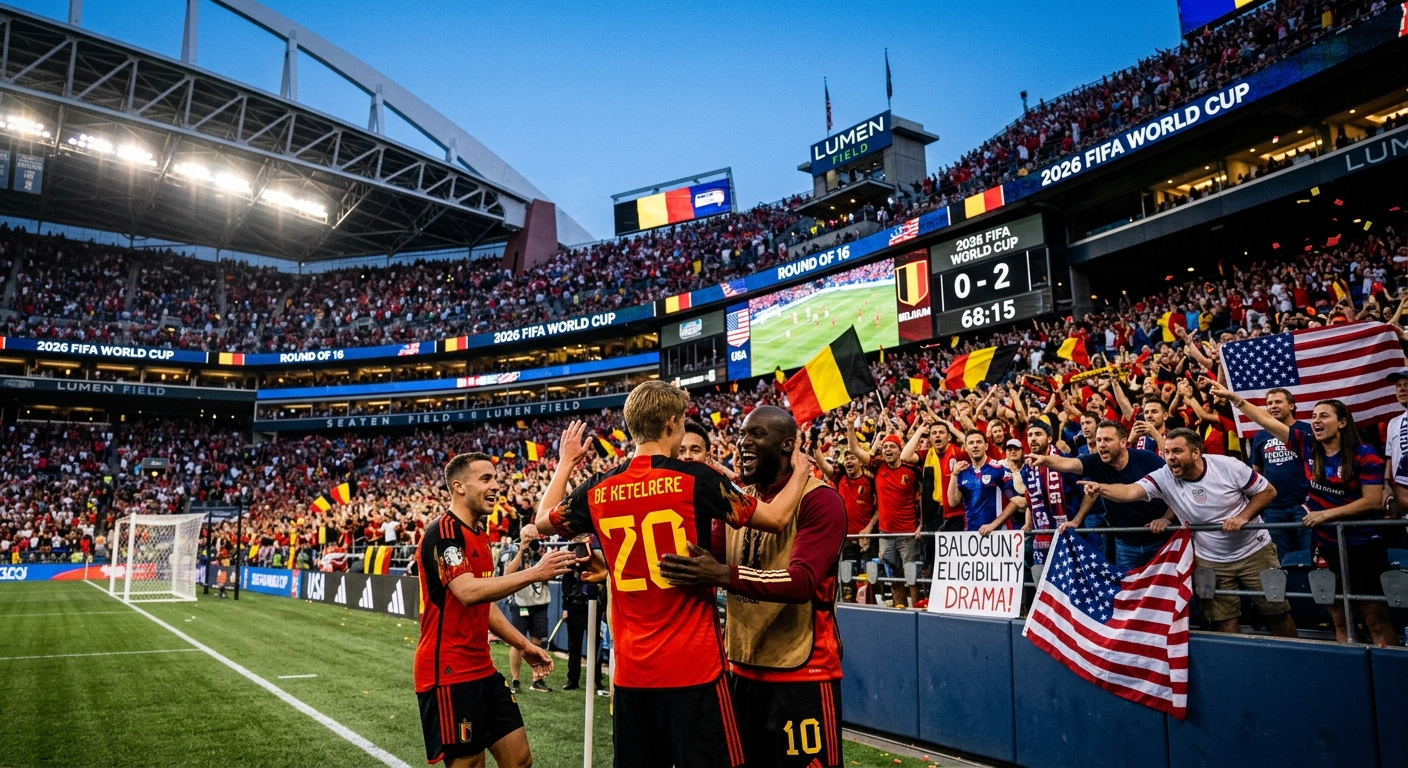
The 2026 FIFA World Cup round of 16 match between the United States and Belgium ended in a surprising and decisive 4–1 victory for Belgium, marking the Red Devils’ progression to the quarterfinals for the third consecutive tournament. The game, held at Lumen Field in Seattle, showcased Belgium’s offensive prowess, highlighted by Charles De Ketelaere’s two goals and Romelu Lukaku’s late clincher after coming off the bench. Despite the United States’ efforts and the return of key attacker Folarin Balogun, the American side was unable to contain Belgium’s experienced and tactically flexible squad.
The match was notably overshadowed by controversy surrounding Balogun’s eligibility to play. Initially suspended following a red card in the previous round, Balogun’s ban was controversially lifted after a personal intervention by then-President Donald Trump, who reportedly contacted FIFA President Gianni Infantino to appeal the decision. This unprecedented reversal sparked widespread criticism and allegations of political interference in the tournament, with commentators and officials questioning the integrity of FIFA’s disciplinary process and expressing concern over favoritism toward the U.S. team.
Tactically, the match highlighted a clash between the U.S. team’s aggressive, front-foot approach under coach Mauricio Pochettino and Belgium’s possession-based style, led by experienced stars like Thibaut Courtois and Kevin De Bruyne. While the U.S. aimed to disrupt Belgium’s rhythm and capitalize on quick transitions, Belgium’s clinical finishing and tactical adaptability ultimately secured a comprehensive win. The result underscored Belgium’s status as one of the tournament’s elite teams and marked a disappointing end to the U.S. World Cup run despite moments of promise.
Beyond the scoreline, the match and its surrounding controversies have sparked debate about the role of political influence in international sport and the challenges faced by emerging soccer nations like the United States in navigating high-stakes competitions. The fallout from Balogun’s suspension reversal remains a defining narrative of the 2026 World Cup, casting a complex shadow over the U.S. team’s performance and the broader tournament integrity.
Background
The match between the United States and Belgium took place in the round of 16 of the tournament, with kickoff scheduled for 8 p.m. Prior to the game, detailed analysis and live commentary were made available through platforms like FotMob and AiScore, providing fans with live scores, statistics, and in-depth insights on team form and head-to-head history. Historically, Belgium held a dominant record over the United States, with four wins to the U.S.’s single victory and no draws between the teams.
The United States team fielded a starting lineup that notably included Ricardo Pepi, who replaced the injured Christian Pulisic, as depicted in a controversial artificial intelligence-generated image by DHS showing the players standing in front of a soccer net situated behind a border wall—an image that drew attention for its political undertones. The term “Attendee” for the event encompassed a broad group including U.S. Soccer’s staff, board members, athletes, coaches, referees, fans, media, and other related personnel.
The inclusion of Folarin Balogun in the U.S. squad, following a last-minute reversal of his national team allegiance, stirred significant debate. Critics viewed this decision as politically motivated and potentially damaging to the integrity of the tournament. Prominent commentators, such as Piers Morgan and Nicholas Kristof, expressed concerns that the move could be perceived internationally as favoritism and undue political influence on FIFA. Despite this controversy, Balogun was considered a key component of the U.S. team’s competitive and aggressive playing style, which was expected to be maintained under head coach Mauricio Pochettino.
Teams
The United States men’s national team (USMNT) entered the match having found a strong lineup that had been effective when fully available. This was the third time in five World Cup games that the team’s preferred starting eleven took the field together, emphasizing the importance of cohesion and familiarity among the players. Despite the absence of key goal scorers like Christian Pulisic, Sergiño Dest, Weston McKennie, and Ricardo Pepi earlier in the tournament, the team had managed to progress through four matches without them finding the net, demonstrating the squad’s depth and resilience. The unexpected availability of Folarin Balogun, following a last-minute suspension lift by FIFA, was a major boost for the USMNT. Balogun’s movement, timing, and attacking threat had already proven crucial in the group stage, providing the team with a dynamic presence in the forward line. The U.S. defensive line consisted of a mix of experienced and younger players, including defenders like Miles Robinson and Antonee Robinson, all tasked with containing Belgium’s potent offense.
Belgium arrived as one of the most formidable teams faced by the USMNT in the tournament, boasting a rich blend of experience and talent from the so-called “old guard.” Key figures such as goalkeeper Thibaut Courtois, midfielder Kevin De Bruyne, and striker Romelu Lukaku provided both leadership and technical quality. In preparation for the World Cup, Belgium had compiled an impressive undefeated streak of 11 wins and 6 draws across all competitions, featuring a +40 goal differential. Although coach Domenico Garcia made surprising tactical decisions by benching both De Bruyne and Jeremy Doku at the start of the match, the team still maintained a strong attacking threat. Dodi Lukebakio was introduced to add pace and creativity on the wing, while Lukaku came off the bench to make a significant impact, underscoring Belgium’s depth and tactical flexibility. Defensively, Belgium fielded a less recognizable central partnership than in previous years, relying on Brandon Mechele and Arthur Theate to manage the backline. The Belgian squad’s combination of defensive solidity and offensive flair posed a stern challenge to the U.S. defense, which was aware of the individual brilliance that players like Trossard and Doku could offer if given space.
Match Summary
The match between the United States and Belgium ended in a decisive 4-1 victory for Belgium, a result that saw the Red Devils advance to the World Cup quarterfinals for the third consecutive time. Belgium took an early lead just nine minutes into the game when Charles De Ketelaere capitalized on a well-placed pass from Nicolas Raskin, heading the ball into the net to give Belgium the advantage. De Ketelaere continued to influence the match heavily, scoring a second goal with a far-post header off a cross from Leandro Trossard, reclaiming the lead for Belgium after a U.S. equalizer.
The United States initially managed to pull back a goal, but Belgium’s offense quickly reasserted control. Hans Vanaken scored the third goal following a critical error by U.S. goalkeeper Matt Freese, who lost possession far from his goal, allowing Vanaken an easy finish. Romelu Lukaku sealed the win in stoppage time with Belgium’s fourth goal, ending any remaining hopes for the U.S. team in the match.
Belgium dominated offensively throughout the game, maintaining 53% possession and creating numerous chances, including five shots on goal in the first half compared to only one from the U.S.. The Belgians also generated four big chances before halftime, reflecting their control in the attacking third.
Despite the loss, the U.S. saw the return of Folarin Balogun, who was unexpectedly available after a FIFA ruling lifted his suspension, bringing back their most significant attacking threat. However, Belgium’s consistent pressure and effective attacking play, led by players such as De Ketelaere, Vanaken, and Lukaku, proved too strong for the American side.
Belgium’s starting lineup featured a strong midfield and forward line, including Thibaut Courtois in goal, Leandro Trossard, and Charles De Ketelaere, who has been a key player despite some earlier struggles to influence matches. De Ketelaere’s performance in this match, which included two goals and an assist, marked a standout display that helped secure Belgium’s victory and progression in the tournament.
Tactical Analysis
The match between the United States and Belgium showcased a clash of contrasting styles and tactical intentions, shaped significantly by player availability and managerial decisions. The U.S. side, managed by Mauricio Pochettino, largely maintained the same starting lineup that secured convincing wins against Paraguay and Bosnia and Herzegovina, emphasizing continuity and stability in their approach. Central to the U.S. game plan was the unexpected return of Folarin Balogun, whose movement, timing, and attacking threat injected a new dimension into the U.S. offense. Balogun’s presence forced Belgium’s defense to contend with a fresh and dangerous problem, disrupting their usual defensive organization on the eve of kickoff.
Pochettino’s tactical setup prioritized aggressive, front-foot football, encouraging midfielders like Weston McKennie and Malik Tillman to break forward and support wide attackers Sergiño Dest and Christian Pulisic in penetrating the opposition’s box with pace and numbers. This approach reflected a balance between maintaining defensive stability and exploiting quick transitions, as the U.S. sought to unsettle Belgium’s possession-based style without relinquishing defensive solidity.
Belgium, on the other hand, fielded a lineup packed with experienced talents, including goalkeeper Thibaut Courtois, midfielder Kevin De Bruyne, and forward Romelu Lukaku, who returned from the bench to make a decisive impact. The Belgian attack demonstrated versatility, shifting between pacey wing play, exemplified by Dodi Lukebakio’s incisive runs cutting inside from the right, and physical presence through Lukaku’s hold-up play. Leandro Trossard and Jeremy Doku were notable for their individual brilliance and ability to trouble the U.S. backline by creating scoring opportunities and maintaining attacking pressure throughout the match.
Despite Belgium’s possession dominance and attacking quality, the game’s intensity was elevated by the U.S. team’s resilience and tactical discipline, fueled by the high stakes of a World Cup knockout fixture and the added intrigue surrounding Balogun’s eligibility and selection. Ultimately, Belgium’s adaptability and clinical finishing overcame the U.S.’s aggressive attempts to control the game, leading to a 4-1 victory that underscored the tactical battle between an experienced European side and a rapidly improving American team.
Player Performances
The match featured notable individual performances from both teams, with Belgium’s Romelu Lukaku standing out as a decisive force. Lukaku, a seasoned striker for Belgium, leveraged his physical presence and finishing ability to great effect, scoring multiple goals that cemented Belgium’s dominance in the game. His ability to capitalize on opportunities was underscored by a goal assisted by Hans Vanaken late in the match, highlighting Lukaku’s role as the focal point of Belgium’s attack.
Belgium’s attacking threat was further bolstered by players such as Leandro Trossard and Charles De Ketelaere. De Ketelaere, who had a notable club season with Atalanta following his loan from AC Milan, contributed significantly by scoring twice in the match. His rising international profile was evident from his earlier exploits, including goals and assists in European competitions and his first international goal in 2021.
On the U.S. side, the appearance of Folarin Balogun was a focal point of discussion, as his availability came after FIFA’s controversial suspension reversal. Balogun’s inclusion added a new dimension to the U.S. attack, with his start marking a pivotal change in the team’s approach. However, despite this injection of talent, the U.S. struggled to convert chances. Other forwards like Christian Pulisic, Ricardo Pepi, and Tim Weah contributed throughout the tournament, but their scoring drought continued in this match.
Defensively, the U.S. made substitutions such as Max Arfsten replacing Antonee Robinson in an attempt to stabilize the backline, but Belgium’s offensive pressure proved overwhelming. Midfielders like Weston McKennie and Gio Reyna showed competitive spirit, though they were unable to significantly impact the scoreline. Malik Tillman managed to pull one goal back for the U.S. from a free kick, providing a momentary glimmer of hope in the match.
Timeline and Key Events
The match between the U.S. Men’s National Team (USMNT) and Belgium was marked by several pivotal moments that shaped the outcome. Early in the game, the United States managed to score the opening goal, but Belgium quickly responded to take control. A significant turning point came in the 57th minute when U.S. goalkeeper Matt Freese made a critical error by losing possession far outside the box, allowing Hans Vanaken to score an easy goal and level the match. Later, in stoppage time, Romelu Lukaku sealed Belgium’s victory with a fourth goal, eliminating any doubt about the final scoreline of 4-1.
Off the field, the USMNT faced additional drama concerning their key striker, Folarin Balogun. Balogun had initially received a controversial red card during the Round of 32 victory over Bosnia and Herzegovina, which would have led to a one-match suspension and sidelined him for the crucial match against Belgium. However, following a high-profile intervention by then-President Donald Trump, who publicly criticized the red card decision as “horrible” and unfair, FIFA reversed the suspension, allowing Balogun to take the field against Belgium.
In the lead-up to the match, oddsmakers considered Belgium a strong opponent, rating the contest nearly as a coin-flip in terms of outcome, especially after the news of Balogun’s reinstatement temporarily shifted the odds in favor of the United States. Throughout the game, live commentary and real-time odds provided fans with insights into the shifting momentum and favored players, enhancing the viewing experience even for those unable to watch the match directly.
Aftermath
The aftermath of the USA’s 4-1 defeat to Belgium was marked by significant controversy and widespread reaction. The match itself saw Belgium dominate, scoring early and repeatedly to secure their victory, with goals from Charles De Ketelaere and Hans Vanaken highlighting defensive lapses from the U.S. side. Despite the loss, Malik Tillman’s goal provided a moment of hope for the U.S., demonstrating some of the team’s untapped potential.
However, the most contentious issue emerged off the field with the sudden reversal of Folarin Balogun’s suspension by FIFA, allowing him to take the field for the U.S. This decision shocked the soccer world and sparked a wave of criticism and speculation. The Belgian Football Federation publicly defended their stance on the integrity and ethics of football in response to the controversy. Meanwhile, U.S. coach Mauricio Pochettino, who had been focused on preparing the team, stated he was not involved in the administrative aspects of the decision and remained focused on the match itself.
Critics and commentators viewed FIFA’s reversal as potentially influenced by external pressures, with some suggesting it cast a shadow over the U.S. team’s unexpected run in the tournament. Public figures including Piers Morgan and Nicholas Kristof voiced concerns about perceived favoritism and political influence affecting the sport’s fairness. The controversy added a complex layer to the U.S. squad’s performance and the broader narrative of their World Cup campaign.
Despite the setback, there remains optimism about the U.S. team’s future prospects, especially if key players who had yet to score begin to find the net. The balancing act between defensive stability and maintaining the team’s identity will be crucial going forward. Ultimately, the defeat ended the U.S. dream at this World Cup, but the experiences and lessons from the tournament are likely to shape the team’s development in the years ahead.
Controversies
The match was overshadowed by significant controversy surrounding the suspension of U.S. striker Folarin Balogun’s
Statistics
The head-to-head statistics between the United States and Belgium have been closely tracked, providing a comprehensive comparison of both teams before their matches. The United States men’s national soccer team (USMNT) has detailed records of matches played, wins, losses, ties, goals for and against, as well as goal differentials dating back to the team’s inception in 1916 through recent games, including their 2024 match against Panama.
In terms of player contributions during recent fixtures, the USMNT roster features forwards such as Brenden Aaronson, Folarin Balogun, and Christian Pulisic, with Balogun notably making his mark after coming onto the field following a controversial FIFA call. The defense and midfield units include key players like Sergiño Dest, Miles Robinson, and Weston McKennie, all contributing to the team’s overall dynamics. After a notable 2-0 victory over Bosnia and Herzegovina in the Round of 32, the USMNT secured its second knockout stage win ever, illustrating their growing competitiveness on the international stage.
Match statistics from recent encounters show the USMNT’s goals scored and conceded, as well as assists and goal difference, placing them tied within the mid-tier ranks globally with 9 goals scored and 4 goals conceded in their latest assessments. Belgium’s squad includes versatile attackers such as Leandro Trossard and Jeremy Doku, whose individual brilliance poses significant threats to the US defense, alongside the goal-scoring prowess of Romelu Lukaku, who made an impact off the bench in recent games.
Live score platforms like AiScore and Sofascore provide ongoing updates and detailed statistics, including live match events such as goals, assists, substitutions, and cards, helping fans and analysts track performance in real time. Additionally, live odds and insights offer contextual understanding of match favorites and outcomes throughout the stages of the game.
Broadcasting and Audience
The highly anticipated match between the United States and Belgium in the 2026 FIFA World Cup was widely accessible through various broadcasting platforms across major territories. In the United States, the game took place at Lumen Field in Seattle, drawing significant viewer interest. Fox Sports and its associated networks, including SPEED and SPEED.COM, provided comprehensive coverage of the event, supported by a range of popular sports shows such as The Herd with Colin Cowherd and The Joel Klatt Show.
Fans could also follow live updates and detailed statistics through several digital platforms. Sofascore offered real-time scores, video highlights from multiple top-tier leagues, and community-driven insights to aid fans in predicting outcomes, although it did not provide direct betting options. Similarly, AiScore delivered live scores, league tables, and fixtures from a broad spectrum of global football competitions, ensuring continuous engagement for soccer enthusiasts worldwide.
Additionally, The Athletic featured live coverage of the USMNT versus Belgium match, emphasizing the high stakes and excitement surrounding this Monday night showdown in Seattle. Expert commentary and analysis were enriched by broadcasters like Kyle Bonn, a Syracuse University graduate specializing in soccer tactics and data analytics, whose decade-long experience lent depth to the broadcast.
Together, these broadcasting channels and digital services ensured that the match reached a vast and diverse global audience, highlighting the significance of the encounter in the 2026 FIFA World Cup context.
The content is provided by Sierra Knightley, 9 Minute Read