
Summary
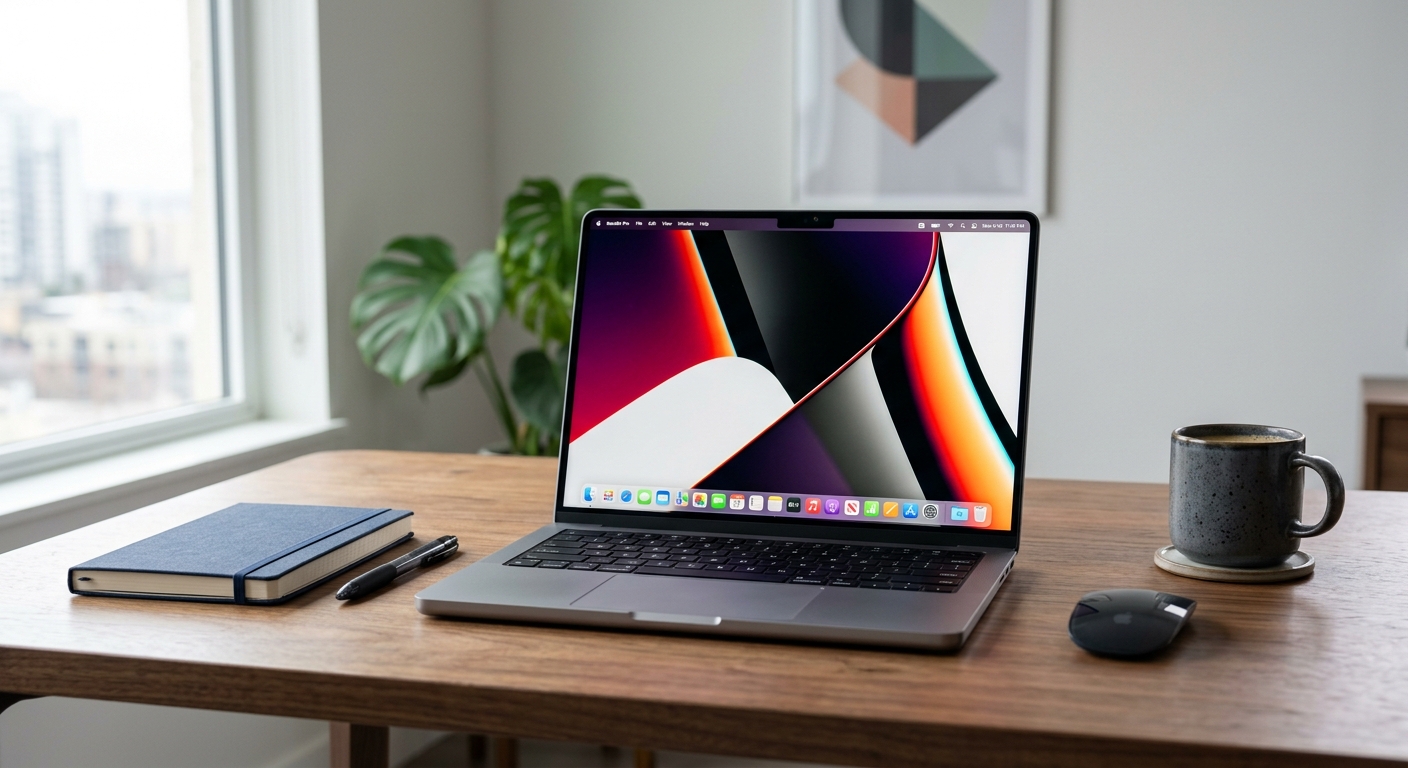
The upcoming entry-level MacBook Pro represents a significant update to Apple’s laptop lineup, featuring a refreshed design that aligns more closely with the company’s higher-end MacBook Pro models. Expected to debut with a modernized 14-inch chassis, the new design incorporates features such as an HDMI port and SDXC card slot, previously reserved for premium models, and is rumored to include a transition from mini-LED to OLED displays for a thinner and lighter device. This redesign aims to unify Apple’s MacBook aesthetics while enhancing durability through improvements like a reinforced hinge mechanism.
Under the hood, the entry-level MacBook Pro is set to showcase Apple’s latest silicon chips, including the M5 Pro and M5 Max, which deliver substantial gains in CPU, GPU, and AI performance compared to prior generations. These chips support increased unified memory bandwidth and faster SSD storage speeds, catering to professionals and creatives who require robust computational power and efficient workflows. The laptops also offer advanced media engines optimized for high-performance video processing and support macOS Tahoe, Apple’s newest operating system that introduces generative AI features and enhances user productivity.
macOS Tahoe, shipping with the new MacBook Pro models, brings notable software improvements such as expanded personalization, enhanced core apps, and energy-saving Low Power Mode, designed to extend battery life while balancing performance needs. This release marks a transition point as it will be the last macOS version supporting Intel-based Macs, underscoring Apple’s full shift to its custom silicon platform. The integration of hardware and software innovations positions the entry-level MacBook Pro as a compelling option for users seeking powerful yet accessible professional-grade laptops.
Reception of the new entry-level MacBook Pro has highlighted enhancements like Center Stage support in the 12-megapixel webcam and improved Liquid Retina XDR displays, which offer higher brightness and the option of a nano-texture glass screen to reduce glare. While praised for these advancements, some debates persist regarding build quality nuances and the performance impact of new software power management features. Overall, the refreshed MacBook Pro reflects Apple’s continued commitment to refining its laptop offerings to meet evolving user demands in design, performance, and software capabilities.
Design
The upcoming entry-level MacBook Pro is expected to feature a refreshed design that aligns more closely with Apple’s higher-end laptop models. The new 14-inch MacBook Pro will reportedly adopt a modernized aesthetic, marking a departure from previous iterations and bringing a more uniform look across the MacBook lineup. This redesign is anticipated to incorporate a chassis similar to the one introduced in earlier models that reintroduced the HDMI port and added an SDXC card slot for camera users.
Significant changes are projected for the 2026 MacBook Pro model, which is rumored to transition from mini-LED to OLED displays, resulting in a notably thinner and lighter device according to Bloomberg. Additionally, Apple is expected to refine the hinge mechanism to reduce screen movement during touch interactions, further distinguishing the MacBook Pro from the MacBook Air and the entry-level MacBook Neo. This hinge reinforcement will contribute to the most substantial design update of the flagship MacBook Pro in years.
The nano-texture display option, first introduced with the Pro Display XDR in 2019, is now available on MacBook Pro models for the first time. This screen features glass etched at the nanometer scale to reduce glare and reflections without compromising image quality, offering users a premium visual experience. Despite the matte finish, the nano-texture display remains an LCD panel requiring backlight illumination to be visible, particularly in bright environments.
Regarding build quality, the entry-level MacBook Pro continues to utilize an aluminum alloy chassis consistent with previous models, maintaining the robust and premium feel associated with Apple’s laptops. While some users have perceived variations in material recyclability and finish between the M1 and earlier Intel-based models, the general consensus is that the build quality remains identical across generations, with only keyboard improvements distinguishing the newer models.
Hardware Specifications
The configuration tested includes the M1 Pro chip with a 10-core CPU, 16-core GPU, 16GB of unified memory, and 1TB of storage, showcasing robust performance capabilities.
Apple’s MacBook Pro lineup has seen consistent improvements in CPU and GPU performance, with the M5 Pro and M5 Max chips delivering up to four times the AI performance of previous generations, enabled by the world’s fastest CPU core and next-generation GPU cores integrated with Neural Accelerators. These chips also feature increased unified memory bandwidth — 307GB/s for M5 Pro models, and up to 614GB/s for the M5 Max models — facilitating faster data handling and more efficient workflows, especially for developers, researchers, and creatives.
Memory options for the M5 Pro and M5 Max models start at 24GB and 36GB respectively, underscoring the high-performance focus of these laptops. Notably, memory upgrades are not possible post-purchase, so users are encouraged to select their desired RAM capacity upfront. Storage solutions have also been enhanced, with SSD speeds doubling in the M5 models compared to their M4 predecessors, reaching up to 14.5GB/s and supporting capacities up to 8TB.
Connectivity options vary by chip model. For example, versions equipped with M4 Pro and M4 Max chipsets include three USB-C Thunderbolt 5 ports, enabling faster data transfer speeds and expanded peripheral compatibility. The 14-inch models offer a range of configurations from the entry-level M4 chip paired with 16GB unified memory to the more powerful Pro and Max variants, although the latter options are not available on the 16-inch MacBook Pro.
Apple silicon chips integrate specialized media engines to accelerate video processing while preserving battery life. The M5 series supports hardware-accelerated encoding and decoding for multiple codecs such as ProRes, ProRes RAW, H.264, HEVC, and AV1, which is particularly advantageous for video professionals and content creators.
Software and Features
The latest entry-level MacBook Pro is expected to ship with macOS Tahoe, Apple’s newest operating system version, which introduces a host of enhancements and new features designed to elevate the user experience. macOS Tahoe delivers a striking new design along with Apple Intelligence, a suite of generative AI capabilities deeply integrated across macOS, iOS, and iPadOS, aimed at improving productivity and creativity through smarter, context-aware tools.
Among the key additions in macOS Tahoe are expanded personalization options, improvements to core system apps like Spotlight and Shortcuts, and the introduction of a dedicated Phone app on the Mac, facilitating seamless cross-device communication. The update also focuses on practical enhancements, such as video conferencing optimizations and specialized AI development tools, tailored for professionals working in remote or low-light environments. Notably, macOS Tahoe is optimized for the upcoming M5 Pro and M5 Max chips, ensuring the new hardware is fully supported.
Battery life management is another important feature in macOS Tahoe, with the introduction of Low Power Mode designed to extend usage time when unplugged. Users can choose to enable Low Power Mode only on battery or always, balancing performance and energy savings based on their workflow needs. Tests on an M1 Max MacBook Pro indicate that while Low Power Mode effectively conserves battery, it may impact performance in demanding audio and video production tasks, making it essential for creators to fine-tune settings to match their priorities.
It is also worth noting that macOS Tahoe will be the final macOS version supporting Intel-based Macs, including models such as the 2020 iMac and 2019 MacBook Pro, as Apple transitions fully to Apple silicon with its subsequent macOS Golden Gate release. This shift underlines Apple’s commitment to delivering enhanced software experiences tightly integrated with its own custom hardware architecture.
Market Positioning
Apple’s entry-level MacBook Pro is positioned as a powerful yet accessible option within the broader Mac lineup, bridging the gap between consumer-grade devices and professional workstations. The 2024 refresh notably includes upgrades such as increased base RAM of 16 GB on MacBook Air models starting at $999, signaling Apple’s intent to support more demanding Apple Intelligence tasks without system strain, which also reflects on the Pro models’ positioning as capable machines for professional and creative workflows.
Equipped with M2 Pro and M2 Max chips, the MacBook Pro offers unrivaled power-efficient performance that caters to a wide spectrum of disciplines, including art, science, and app development. This positions the device as a significant upgrade for users transitioning from Intel-based Macs, providing dramatic improvements in performance, battery life, connectivity, and overall productivity. Additionally, the inclusion of a potential touch panel in upcoming MacBook Pro models is expected to further blur the lines between the MacBook and iPad, appealing to users seeking enhanced versatility and productivity features.
Release Information
Apple has announced that the new models of the MacBook Pro will begin arriving to customers and will be available at Apple Store locations and Apple Authorized Resellers starting Wednesday, March 11. The updated lineup includes the 14-inch MacBook Pro with M5 Pro, starting at $2,199 (U.S.) and $2,049 for U.S. education customers, as well as the 16-inch MacBook Pro with M5 Pro, starting at $2,699 (U.S.) and $2,499 for U.S. education pricing. This release follows a period of several announcements from Apple, including a spring 2026 launch that introduced various entry-level and budget products, such as the MacBook Neo, alongside new iPhones, iPads, and MacBook Pros.
Reception
The latest entry-level MacBook Pro models have garnered attention for several notable enhancements and design choices. One of the praised features is the inclusion of Center Stage support with the 12-megapixel webcam, which automatically keeps the user’s face centered during video calls. Previously exclusive to iPads and the Studio Display, this addition has been welcomed as a significant improvement for MacBook users seeking better video conferencing experiences.
Display quality has also been a focal point of discussions. The new models feature LED-backlit “Liquid Retina XDR” displays that offer increased brightness, reaching up to 1000 nits for SDR content outdoors—an upgrade from the 600 nits available on previous generations. This enhancement makes the screens more vibrant and usable in bright environments. Additionally, Apple’s nano-texture glass option, etched at the nanometre level to scatter light and minimize glare, has sparked mixed reactions. Although initially met with concerns about reduced contrast, washed-out blacks, and potential fragility, longer-term user experiences have suggested that these issues are less problematic than anticipated, offering outstanding image quality even in challenging lighting conditions.
Despite the positive feedback on the hardware and display improvements, some users continue to engage in debates regarding build quality and design refinements. For example, certain opinions highlight the improved fit of the logo on the aluminum chassis in newer models, emphasizing Apple’s attention to material and construction details that contribute to the device’s perceived quality.
Beyond hardware, software updates like macOS Tahoe’s Low Power Mode have stirred conversations about their real-world impact on performance, especially for creative professionals working with audio and video. While intended to extend battery life, discussions indicate that users should weigh the trade-offs between energy savings and system responsiveness when utilizing this feature. Meanwhile, broader system improvements and bug fixes in recent macOS updates have contributed to a more stable and responsive user experience.
The content is provided by Blake Sterling, 9 Minute Read