Summary
Nopia is an innovative synthesizer prototype designed to simplify and democratize tonal harmony for musicians of all skill levels. Developed by Argentine musicians and designers Martin Grieco and Rocío Gal, it integrates a unique harmony-focused interface with advanced synthesis and performance features, allowing users to intuitively build complex chords and explore tonal music without extensive music theory knowledge. Since its viral debut in 2023, Nopia has drawn significant attention for its blend of user-friendly controls, expressive capabilities, and distinctive design aesthetics inspired by creators like Love Hultén.
The instrument centers on three main controls—the Chord Builder keyboard, the Tonal Selector buttons, and the Extensions Dial—enabling dynamic chord creation that adheres to principles of tonal harmony. Its multitimbral sound engine combines virtual analogue synthesis with sample-based modules spanning bass, keys, arpeggiator, and pads, each with dedicated MIDI outputs for flexible studio integration. Additional performance features include a multitouch strum plate with polyphonic pitch-bend, a built-in vocoder, and an onboard effects chain, enhancing both live playability and sound design.
Nopia’s development involved years of multidisciplinary collaboration across industrial design, electronics, firmware, and prototyping, culminating in the production-ready Nopia MK1 version by mid-2025. The project’s initial viral success sparked high anticipation within the electronic music community, with media previews highlighting its potential to reshape synthesizer workflows through its harmony-centric approach. However, the project has also faced challenges, including the rise of scam websites exploiting its popularity, prompting creators to caution the public.
Widely praised for its innovative interface and expressive sonic capabilities, Nopia has been recognized as a groundbreaking instrument that bridges experimental design with practical studio use. By making harmonic exploration more accessible and interactive, it has influenced the landscape of MIDI harmony generators and inspired new directions in electronic instrument design. As of 2026, the synthesizer stands poised for official release, with the music technology community eagerly awaiting its arrival.
Overview
Nopia is a synthesizer prototype designed to serve as both a performance-ready instrument and a compositional tool, aiming to make the complexities of tonal harmony more accessible to users unfamiliar with music theory. It focuses on enabling intuitive interaction with the language of harmony, immersing players in real-time musical experience to encourage improvisation, learning, and composition.
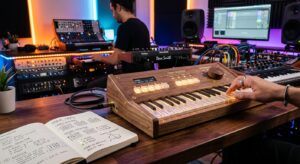
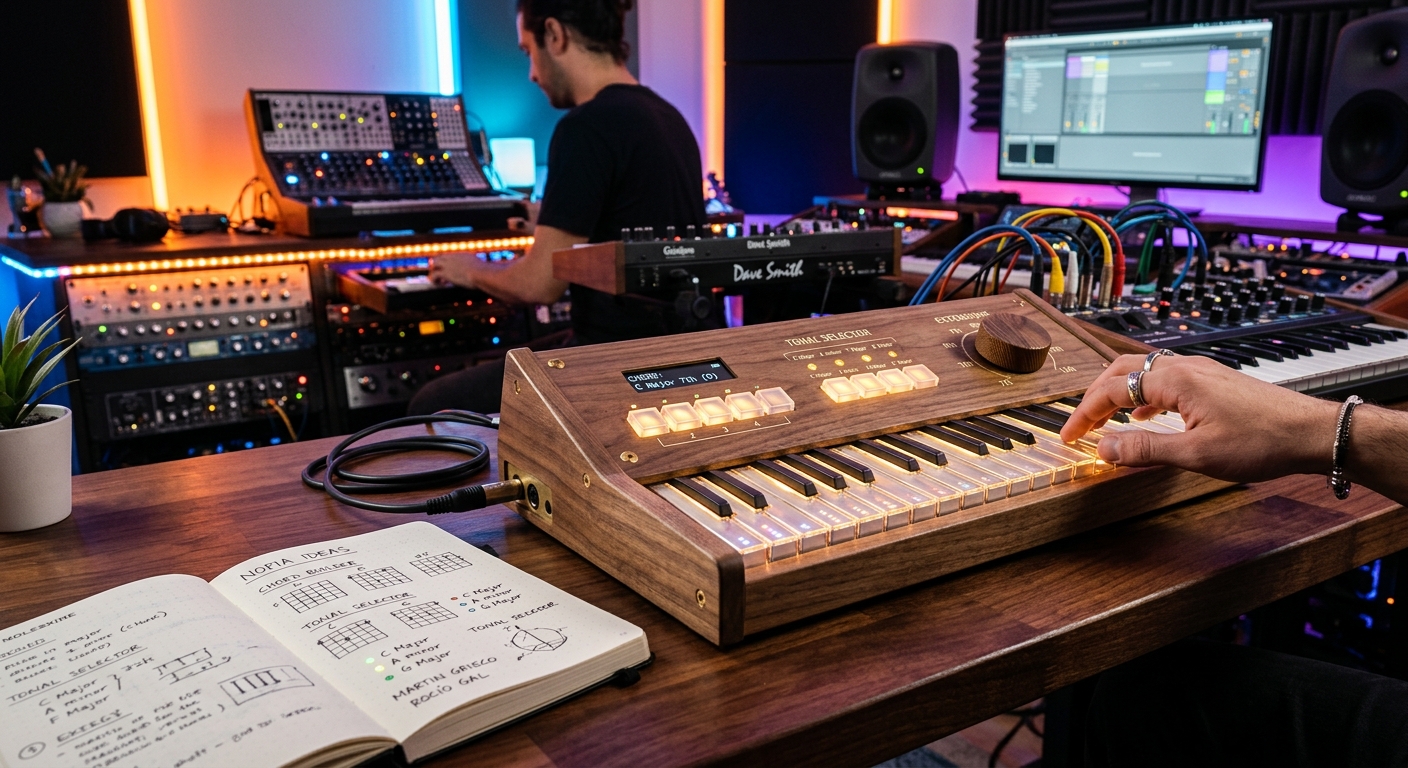
The instrument features a harmony-focused workflow centered on three main controls: the Chord Builder, which is a one-octave keyboard; the Tonal Selector, consisting of 12 buttons arranged in a keyboard-style layout; and the Extensions Dial, which allows further sonic manipulation. Each section of the hardware emits separate MIDI information, enabling individual tracking of different elements such as bass, synth, arpeggiator, and keys, and is complemented by an Ableton rack that allows for sound customization.
Since its initial demonstration, Nopia has evolved from a conceptual prototype into a refined Mk.1 version, with improvements in design and playability while maintaining its core chord-building function that aids and inspires creativity. The development process has involved extensive collaboration across industrial design, electronics, firmware, and prototyping disciplines, reflecting a patient orchestration of diverse expertise to bring the instrument into studios.
History and Development
Nopia was originally conceived by musicians and designers Martin Grieco and Rocío Gal in Buenos Aires, Argentina. The project began as an experimental synth concept focused on tonal harmony and creative chord building, combining innovative musical functions with an elegant, Love Hultén-inspired design aesthetic. The initial prototype was unveiled in 2023, quickly going viral after a video demonstration amassed over three million views within a week, capturing the attention of musicians and synth enthusiasts worldwide.
Following this surge of interest, the creators and their team refined Nopia, transforming it from a prototype into a robust instrument designed to live in studios. This involved interdisciplinary work across industrial design, electronics, firmware development, and prototyping, requiring collaboration across multiple time zones and areas of expertise. Throughout development, the team emphasized durability and user experience, aiming to deliver a synth that inspired creativity and could withstand extensive use.
By mid-2025, development was officially completed, and Nopia entered an exhaustive testing phase to ensure reliability and performance before launch. This production-ready version, named Nopia MK1, features comprehensive connectivity options including per-module MIDI outputs, MIDI input, clock synchronization, stereo audio outputs, USB MIDI, and a sustain pedal jack. It also includes built-in effects such as filter, delay, reverb, saturation, tape emulation, and beat repeat to enhance sonic possibilities.
In late 2025, the team provided exclusive previews to media outlets, demonstrating the nearly finished product and sharing plans for an imminent release, with an expected price around £550, though subject to change. After years of anticipation since its viral debut, Nopia MK1 is poised to become a unique addition to the landscape of MIDI harmony generators and synthesizers, bridging experimental design with practical studio use.
Design and Architecture
Nopia is designed as a harmony-focused synthesizer combining innovative hardware with a user-friendly interface aimed at both novice and expert musicians. Central to its design is a one-octave “chord builder” keyboard that generates chords rather than single notes, enabling players to create complex harmonic structures easily. This keyboard works with a 12-button “tonal selector” laid out in a keyboard style, allowing users to define a key center and produce chords adhering to tonal harmony principles. A dedicated dial above the keyboard lets users modify chord types and add extensions on the fly, enhancing creative flexibility.
The instrument’s architecture is built around four distinct sound modules—Keys, Bass, Arp, and Pad—each with its own dedicated TRS MIDI output. These modules feed into an onboard multitimbral sound engine merging sampled instruments with virtual analogue synthesis, allowing for a rich and versatile sonic palette. The synthesizer includes a five-step effects chain featuring filter, delay, reverb, saturation, tape emulation, and beat repeat to shape and texture the sound further.
For expressive performance, Nopia incorporates a multitouch strum plate capable of gestures such as strumming, chromatic movement, and microtonal pitch-bend. The touch-sensitive plate, along with a slider beneath the tonal selector, enables polyphonic pitch-bending and nuanced control over notes within chords. An OLED display provides real-time feedback by showing chord information and parameter values, improving user interaction and workflow clarity.
Connectivity options are comprehensive, featuring per-module MIDI output via TRS connectors, MIDI input, clock in/out, stereo TRS audio outputs, USB MIDI, and a sustain pedal jack. This facilitates seamless integration into various studio and live setups, allowing users to route individual modules separately for detailed control and layering. Additionally, an Ableton Live rack complements the hardware, offering sound customization and enabling separate MIDI tracking for each section of the instrument, such as bass, synth, arpeggiator, and keys.
The overall design aesthetic echoes influences from designers like Love Hultén and Critter and Guitari, featuring soothing pastel colors, soft lighting, and a quirky one-octave keyboard that create a distinctive and inviting look. The design process involved orchestrating multiple disciplines including industrial design, electronics, firmware, and prototyping across time zones, reflecting a patient and collaborative development journey.
Synthesis Methods and Sound Design
The Nopia synthesizer employs a hybrid synthesis engine integrating virtual analogue synthesis with sample-based sound generation. Its multitimbral sound engine is divided into four modules—Keys, Bass, Arp, and Pad—each drawing from a combination of sampled instruments and virtual analogue synthesis to create rich, layered textures. This architecture allows users to construct complex harmonic soundscapes by selecting chords that are processed through these separate sound modules.
Individual notes within chords can be performed expressively using a touch-sensitive strum plate located on the top-right of the interface, supporting polyphonic pitch-bending and chromatic movement via an adjacent slider beneath the Tonal Selector. This design enables nuanced real-time manipulation of chords, facilitating gestures such as strumming and microtonal pitch bends that enhance performance dynamics.
Sound design is further enriched by an onboard 5-step effects chain comprising filter, delay, reverb, saturation, tape emulation, and beat repeat effects, allowing users to sculpt timbre and atmosphere extensively. Each module benefits from dedicated TRS MIDI outputs, offering expanded connectivity for integration with external gear and software.
The synthesizer includes an arpeggiator that intelligently unfolds notes within each chord, synchronizing with external MIDI clock for rhythmic coherence. Additionally, a synth section provides a slider to blend sounds from two different banks, adding depth and variety to tones. Notably, Nopia features a built-in vocoder, enabling users to modulate their voice through the synthesizer for robotic and melodic vocal effects, an uncommon feature that contributes to its unique sound palette.
Underlying Nopia’s sound design philosophy is the concept of “Tonal Harmony,” which automates chord construction and progression, removing the need for extensive music theory knowledge while fostering creativity. This harmonic approach, combined with hybrid synthesis capabilities and expressive controls, positions Nopia as a distinctive instrument in modern synthesis.
Functionality and Performance Features
Nopia is designed around a harmony-focused workflow integrating intuitive controls and advanced sound generation. Central are three core elements: the Chord Builder, a one-octave keyboard generating chords; the Tonal Selector, with 12 keyboard-style buttons setting the key signature; and the Extensions Dial, modifying chord types and adding harmonic extensions. Together, these controls enable users to create sequences and chords adhering to tonal harmony principles without requiring extensive music theory knowledge.
The instrument’s sound engine is multitimbral, combining sampled instruments with virtual analogue synthesis across four modules—Keys, Bass, Arp, and Pad. Each produces unique sounds from this hybrid engine, allowing for rich, layered textures. Individual notes can be played via a multitouch capacitive strum plate, supporting expressive gestures such as strumming, chromatic movement, and microtonal pitch-bend. Polyphonic pitch-bend is accessible through a slider beneath the Tonal Selector, adding dynamic articulation between chords.
Onboard effects include a 5-step chain with filter, delay, reverb, saturation, tape emulation, and beat repeat, enhancing sound design and live performance expressiveness. An OLED display provides real-time feedback on chord information and parameters, facilitating an intuitive experience.
Connectivity supports extensive performance and production needs. Each sound module has a dedicated TRS MIDI output for individual MIDI routing and integration with external gear or software. Additional connections include MIDI input, clock synchronization (in/out), stereo TRS audio outputs, USB MIDI, and a sustain pedal jack, allowing flexible setups in studio or live environments.
Further features include an arpeggiator unfolding notes within chords, a synth engine blending sounds from two banks, and a built-in vocoder for modulating the user’s voice with robotic and melodic effects. These, combined with its minimalistic yet aesthetically pleasing design, contribute to its growing international recognition among audiophiles and electronic musicians.
Production and Release
The Nopia synth, a semi-modular chord generator from Argentina, first gained widespread attention in 2023 when creators Martin Grieco and Rocío Gal shared a prototype video that went viral, amassing nearly three million views within a week. Following this surge, the development team refined the instrument, transforming it from a concept into a durable, studio-ready device. This process involved orchestrating industrial design, electronics, firmware, and prototyping efforts spanning multiple disciplines and time zones.
By mid-2025, development was completed, and Nopia entered an exhaustive testing stage to ensure durability and performance before launch. Although an exact release date had not been firmly set as of mid-2023, the team planned to launch Nopia MK1 within a few months, with a tentative price around £550, subject to change. The production model includes separate MIDI outputs for bass, synth, arpeggiator, and keys, allowing detailed sound customization via a complementary Ableton rack.
As of mid-2026, updates on development progress and availability signaled the finish line was in sight for this much-anticipated instrument.
Reception
The Nopia synthesizer has garnered significant attention and acclaim within the electronic music community due to its innovative approach to harmony and user interface. Its launch video went viral rapidly, accumulating over 2.1 million views in six days, establishing the synth as highly anticipated. This viral success was driven by Nopia’s unique “harmony machine” concept that enables musicians to build complex chords and modulations on a compact keyboard, unlike any other synthesizer available.
Critics and enthusiasts have praised the design and functionality. Developed by musicians Martin Grieco and Rocío Gal with a dedicated team, Nopia combines multitouch capacitive sensors with gesture-based pitch bend controls and a sophisticated chord builder, allowing chromatic and microtonal playability across four sound modules (Bass, Keys, Arp, and Pad). Its internal sound engine supports both sample-based and virtual analog synthesis, expanding sonic versatility.
The built-in vocoder produces robotic yet melodic vocal effects reminiscent of Daft Punk, enhancing creative possibilities. Music journalists have lauded Nopia’s innovative approach to tonal harmony as a “key, a way, a love letter to music,” filling a niche unexplored by existing hardware instruments.
Despite its hype and positive reception, the project faced challenges including scam websites exploiting its viral success, which the creators have actively cautioned against. Nonetheless, anticipation remains high with a growing waitlist on the official website. Its presence at major industry events such as Superbooth 2026 has further solidified its reputation as a groundbreaking instrument in the synthesizer landscape.
Influence and Impact
Nopia has made a significant impression on both the electronic music community and the wider world of music technology since its initial conception. Its unique approach to harmony and performance—allowing users to engage with tonal music without deep music theory knowledge—has opened new creative avenues for musicians of all skill levels. The synth’s accessible design and innovative interface have resonated strongly with users seeking intuitive and expressive tools.
The launch of Nopia’s prototype video sparked viral attention, amassing over 2.1 million views within six days, highlighting its appeal and the growing interest in alternative musical interfaces combining industrial design with practical musical functionality. The viral success underscored how Nopia’s blend of aesthetics and functionality challenged traditional keyboard-based instruments and introduced a fresh perspective on interactive harmony.
Moreover, its development involved multidisciplinary collaboration bridging time zones and expertise in industrial design, electronics, firmware, and prototyping. This collaborative effort reflected the complexity behind its creation and showcased the dedication of a passionate team producing a durable, studio-ready instrument. The project’s evolution from an experimental prototype to a near-market product has inspired other designers and musicians to explore innovative music-making solutions.
By focusing on a harmony-driven multitimbral sound engine integrating virtual analogue synthesis with sample-based modules—Keys, Bass, Arp, and Pad—Nopia has influenced how synthesis and performance interfaces can be conceived. Its touch-sensitive controls and polyphonic pitch-bend functionality have expanded expressive capabilities available to performers. Overall, Nopia’s impact lies not only in technological innovations but also in democratizing harmonic exploration and inspiring new directions in electronic instrument design.
The content is provided by Blake Sterling, 9 Minute Read