Summary
The Neil Gehrels Swift Observatory, launched by NASA in 2004, is a pioneering space telescope dedicated to the study of gamma-ray bursts (GRBs)—the most energetic explosions in the universe arising from massive star deaths and compact object collisions. Equipped with gamma-ray, X-ray, and ultraviolet/optical instruments, Swift has played a critical role in rapidly detecting and localizing GRBs, enabling timely follow-up observations worldwide. Over nearly two decades of operation, it has revolutionized our understanding of transient high-energy astrophysical phenomena and contributed to diverse discoveries ranging from cometary activity to brown dwarfs.
Despite its scientific success, Swift faces a grave threat from accelerated orbital decay caused by increased atmospheric drag linked to heightened solar activity. This decay risks an uncontrolled re-entry and destruction of the spacecraft as early as 2026. Compounding the challenge, Swift was not designed for on-orbit servicing and lacks docking fixtures, rendering conventional repair or refueling missions unfeasible. In response, NASA partnered with commercial aerospace firm Katalyst Space Technologies to undertake an unprecedented robotic servicing mission using the autonomous LINK spacecraft, designed to rendezvous with, capture, and raise Swift’s orbit to a safer altitude.
The mission represents a milestone in satellite servicing technology and public-private collaboration, marking the first time a commercial robotic spacecraft will service an active NASA science satellite not originally engineered for in-space maintenance. LINK’s operation involves complex autonomous rendezvous, capture using robotic arms, and gradual orbital boosting via ion propulsion, aiming to extend Swift’s operational life by up to two decades and preserve its vital astrophysical capabilities. This effort also exemplifies a strategic shift in NASA’s approach toward leveraging commercial innovation for maintaining and prolonging valuable orbital assets.
By preventing Swift’s premature loss, the mission not only safeguards an essential observatory for transient astronomy but also paves the way for sustainable, cost-effective satellite servicing practices. It establishes critical precedent for extending the lifespan of aging spacecraft, reducing space debris, and enabling future on-orbit repairs and upgrades, thereby supporting a more resilient and adaptable space infrastructure.
Background
The Neil Gehrels Swift Observatory, launched in 2004, is a NASA space telescope designed to study gamma-ray bursts (GRBs), which are among the most powerful explosions in the universe caused by the deaths of massive stars and the collisions of their remnants. Equipped with three instruments, including gamma-ray, X-ray, and ultraviolet/optical telescopes, Swift has been pivotal in detecting and rapidly localizing GRBs, enabling follow-up observations by other telescopes worldwide. Over its mission, Swift has discovered more than 1,700 gamma-ray bursts and contributed to a wide range of astronomical discoveries, including observations of comets, brown dwarfs, and microlensing events.
Despite its scientific success, the observatory has faced challenges due to orbital decay accelerated by recent solar storms, which have lowered its altitude and put it at risk of re-entering Earth’s atmosphere and being destroyed as soon as 2026. Swift was not originally designed with docking fixtures or servicing capabilities, complicating any efforts to extend its operational life through in-orbit servicing. Recognizing the importance of preserving this unique astrophysics asset, NASA initiated an ambitious and unprecedented mission to boost Swift’s orbit using a robotic servicing spacecraft named LINK, developed by Katalyst Space Technologies. LINK is equipped with ion engines, robotic arms, and advanced sensors to rendezvous with, capture, and raise Swift’s orbit, potentially preventing its destruction and allowing continued scientific observations.
This mission represents a critical step forward in satellite servicing technology and marks the first attempt by a commercial robotic spacecraft to capture and extend the life of a NASA science satellite that was not designed for in-space servicing. Extending Swift’s mission will maintain its vital role in the study of the dynamic and transient universe, ensuring that researchers can continue to observe and analyze the fleeting and energetic events that shape our cosmos.
Imminent Threat to the Observatory
Since its launch in 2004, NASA’s Neil Gehrels Swift Observatory has been a crucial tool for detecting and studying gamma-ray bursts and other high-energy cosmic phenomena. However, after more than two decades in low Earth orbit, the spacecraft now faces a critical threat of uncontrolled reentry due to accelerated orbital decay.
The root cause of this threat is increased solar activity, which has heated and expanded Earth’s upper atmosphere, raising its density at higher altitudes. This expansion increases atmospheric drag on satellites like Swift, causing their orbits to decay faster than anticipated. Specifically, the recent surge in solar storms has intensified this effect, pushing Swift into a faster-than-expected descent towards Earth.
This orbital degradation is further compounded by the aging spacecraft’s declining functionality. Notably, two of its four onboard gyroscopes have failed, forcing Swift to operate in a limited two-gyroscope mode with software patches. These technical challenges heighten the risk of loss of control and complicate efforts to maintain its orbit.
According to assessments by Katalyst, the company contracted by NASA to intervene, Swift has approximately a 50% chance of making an uncontrolled reentry by mid-2026. This probability rises sharply to 90% by the end of 2026 without any corrective action. Such an uncontrolled reentry would result in the destruction of the observatory and the loss of a long-standing capability to monitor gamma-ray bursts and other astrophysical phenomena.
Given these circumstances, NASA and its partners have urgently prepared for a servicing mission to stabilize Swift’s orbit and extend its operational life. The mission seeks to intercept the observatory and use robotic arms to grapple and boost it to a safer altitude, preventing its imminent plunge into Earth’s atmosphere.
NASA’s Response and Coordination
In response to the imminent threat of the Neil Gehrels Swift Observatory’s orbital decay, NASA organized a high-stakes mission to prevent the 22-year-old gamma-ray observatory from re-entering Earth’s atmosphere. Recognizing the urgent need to extend Swift’s operational life, NASA partnered with private aerospace firm Katalyst Space Technologies to develop and deploy a robotic servicing satellite named LINK. This collaboration marked a significant shift in NASA’s approach, favoring commercial partnerships following the cancellation of the in-house OSAM-1 mission due to cost overruns.
NASA’s Astrophysics division, led by Shawn Domagal-Goldman, emphasized the mission’s high-risk, high-reward nature and its strategic importance for advancing satellite servicing capabilities. The operation aimed not only to save Swift but also to demonstrate a blueprint for on-orbit maintenance of spacecraft never originally designed for servicing. The mission objectives focused on capturing Swift using LINK’s robotic arms and boosting it into a safer, higher orbit approximately 370 miles above Earth.
To prepare for the complex rendezvous and capture, the Swift operations team adapted the observatory’s observing strategy to minimize atmospheric drag, temporarily suspending science data collection. Concurrently, LINK underwent extensive testing in NASA facilities, including firing ion thrusters and simulating space conditions within the Space Environment Simulator. After launch aboard a Northrop Grumman Pegasus XL rocket, LINK is scheduled to take one to two weeks to reach Swift, during which it will perform detailed imaging and inspection to identify any potential damage and determine optimal capture points.
NASA’s coordination efforts extended beyond technical preparations, involving real-time data processing and autonomous decision-making algorithms onboard LINK to manage communication delays and unexpected orbital dynamics. The mission’s success would not only prolong Swift’s scientific contributions—such as studying gamma-ray bursts and the early universe—but also establish the first commercial spacecraft operation to reposition an operational U.S. government satellite, potentially extending its lifespan by two decades.
The Rescue Mission: LINK Spacecraft
NASA’s urgent effort to save the Neil Gehrels Swift Observatory from an impending destructive re-entry involves a pioneering robotic servicing mission using the LINK spacecraft. LINK, a refrigerator-sized autonomous robot developed by the Arizona-based startup Katalyst Space Technologies, is designed to rendezvous with the decaying Swift Observatory and boost it to a safer orbit, thereby extending its operational life by approximately ten years.
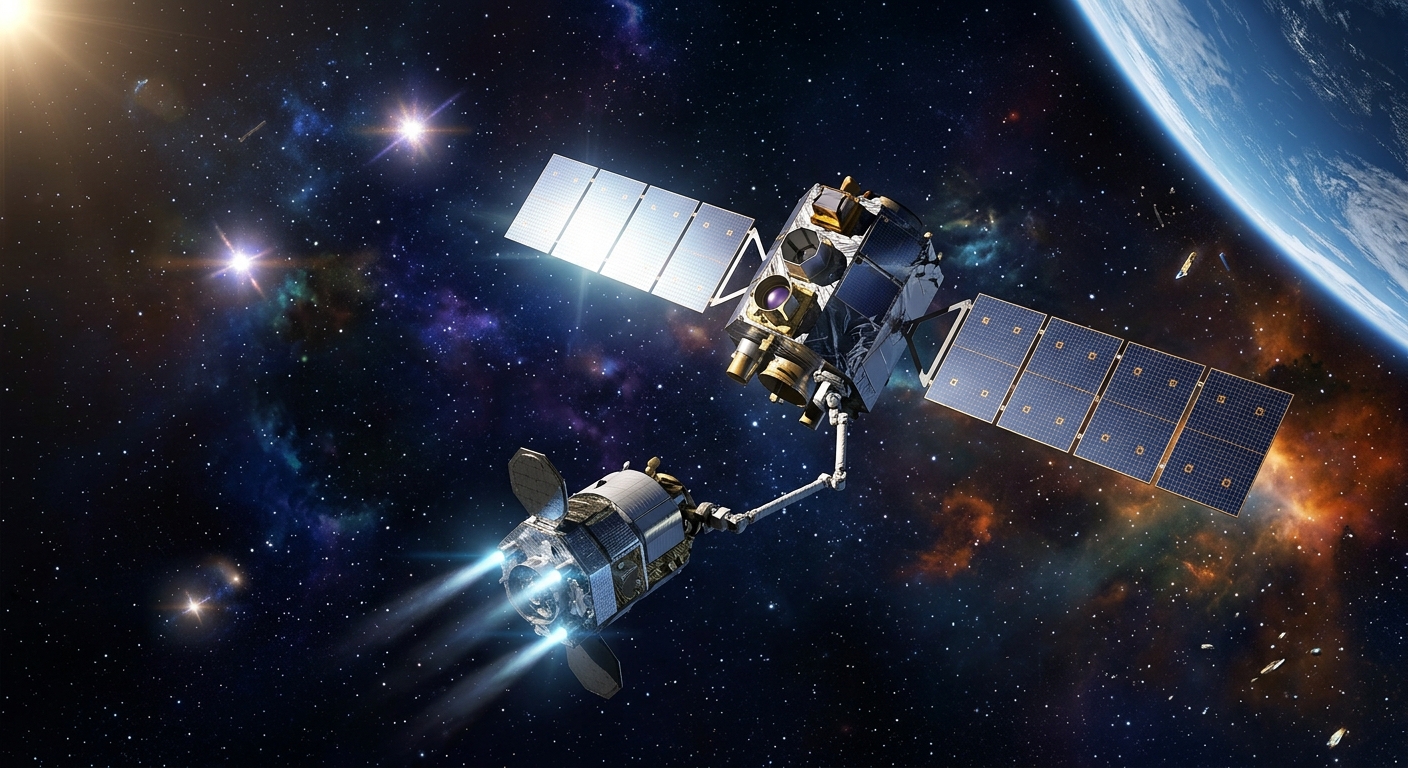
LINK weighs about 940 pounds and is equipped with three robotic arms, 16 orientation control thrusters, three xenon-fueled ion engines, and solar panels capable of generating 4 kilowatts of power. Its sophisticated suite of sensors and onboard autonomous algorithms enable it to conduct complex proximity operations, including inspection, capture, and orbital adjustment maneuvers without real-time human control. The spacecraft’s robotic arms will secure onto pre-existing ground-handling flanges on Swift—features not originally intended for on-orbit servicing—after thorough visual inspections to confirm their condition and accessibility.
Launched from Kwajalein Atoll in the Republic of the Marshall Islands aboard a Northrop Grumman Pegasus XL rocket deployed from a Stargazer aircraft, LINK embarked on its mission in mid-2026. After launch, LINK will spend approximately three to four weeks approaching Swift at a measured pace, sending images back to Earth to allow mission teams to select optimal capture points. This phase is critical to ensure safe docking given that Swift was not designed with servicing ports or grappling fixtures.
Once docked, LINK will engage its ion thrusters to gradually raise Swift’s orbit from its decaying altitude to about 370 miles (approximately 600 kilometers), a maneuver expected to take between 10 and 12 weeks. The reboost will counteract atmospheric drag and orbital decay, preserving Swift’s gamma-ray observatory capabilities and enabling continued rapid-response astrophysical observations. Upon successful completion of the boost, LINK will detach from Swift and conclude its mission, marking a historic first for robotic servicing of an active science satellite not originally designed for on-orbit maintenance.
Extensive ground testing and rehearsals preceded the mission, including operations within NASA Goddard’s Space Environment Simulator and capture practice using a full-sized Swift mockup mounted on an industrial robotic arm. These preparations aimed to validate LINK’s ability to perform delicate manipulations under space-like conditions and to ensure mission safety and success. The mission represents a significant policy and technological milestone, as NASA selected a private company for this critical servicing task following cancellation of its own OSAM-1 mission, signaling a shift towards leveraging commercial capabilities for orbital asset maintenance.
Execution and Outcomes
The execution of the Swift boost mission began with the launch of the LINK spacecraft, developed by Katalyst Space Technologies, aboard a Northrop Grumman Pegasus XL rocket on July 3, 2024, at 4:36 a.m. This launch followed three unsuccessful attempts and marked the final flight of the Pegasus XL rocket, underscoring the high stakes and unique nature of the mission. The primary objective of LINK was to rendezvous with NASA’s aging Swift Observatory, grapple it, and gradually raise its orbit to prevent its impending reentry into Earth’s atmosphere later in the year.
LINK’s design incorporated advanced autonomous algorithms and real-time data processing capabilities, enabling the spacecraft to make critical decisions independently in response to unexpected orbital dynamics or communication delays. This technology was essential given the complexity and novelty of performing the first-ever commercial robotic servicing mission of an uncrewed NASA spacecraft not originally designed for in-orbit servicing.
The mission’s success would not only extend Swift’s operational life by several years but also represent a significant milestone in cost-effective satellite servicing strategies, particularly in light of NASA’s recent shift towards partnering with private enterprises following the cancellation of the in-house OSAM-1 mission due to budget overruns. The rescue effort was motivated by the observatory’s steadily declining orbit, accelerated by increased solar activity that expanded Earth’s atmosphere and increased drag on the spacecraft.
Despite the risks acknowledged by experts, including the potential failure of critical systems such as gyroscopes—two of which had already failed and forced Swift to operate in a limited two-gyroscope mode—the mission proceeded as a strategic effort to preserve an essential astrophysical asset. The observatory, crucial for the study of gamma-ray bursts and other high-energy phenomena, had been reduced to a non-science-operational mode to minimize drag since December prior to the mission.
As LINK approached Swift, it began the delicate process of matching orbit and securing the observatory to initiate a slow altitude boost, expected to span several months. This incremental orbit raise aimed to place Swift into a safer, higher orbit, reducing atmospheric drag and extending its service life significantly. The success of this mission would mark the first commercial robotic spacecraft capture and servicing of a NASA satellite under these conditions, setting a precedent for future satellite servicing and orbital debris mitigation.
The mission’s outcome, as of the latest reports, remains cautiously optimistic. The initial launch and rendezvous phases were completed, but the complex task of maintaining a secure grapple and executing the altitude raise over time is ongoing. The mission exemplifies a critical blend of innovation, risk management, and strategic partnership between NASA and commercial aerospace, demonstrating a promising pathway to sustain valuable space assets beyond their originally anticipated lifespans.
Significance and Future Implications
The mission to reboost the Swift Observatory holds considerable significance both scientifically and technologically. Extending Swift’s operational life would enable continued rapid-response observations, preserving a vital asset for time-sensitive astrophysics investigations. Rather than allowing the telescope to re-enter Earth’s atmosphere, NASA seized this opportunity to demonstrate an innovative orbital servicing capability that promises cost efficiency and scientific continuity.
Beyond the immediate benefits to Swift’s science mission, the project serves as a strategic blueprint for the future of space operations. It showcases how spacecraft not originally designed for on-orbit maintenance can be repositioned, repaired, refueled, or refitted through robotic servicing missions. This capability is essential for building a sustainable human and robotic presence beyond Earth, enabling longer lifespans for satellites and observatories, and reducing the need for costly replacements.
If successful, this mission will mark the first time a commercial spacecraft has captured and repositioned an operational U.S. government satellite that was not designed for servicing, potentially extending Swift’s functional lifespan by up to two decades. This milestone could revolutionize spacecraft maintenance, enabling NASA and other agencies to preserve and enhance a wide range of aging but scientifically valuable satellites.
The demonstration of rapid, cost-effective orbital reboost also aligns with NASA’s broader goals of advancing space robotics and autonomous servicing technologies. The contract awarded to Katalyst Space Technologies to carry out this mission using the LINK spacecraft highlights a growing partnership between government agencies and commercial innovators in developing new space capabilities.
Ultimately, this mission not only preserves a key scientific observatory but also paves the way for a new era of on-orbit satellite servicing. By overcoming challenges inherent in satellite capture and repositioning, NASA is establishing methods that could become standard practice, supporting an enduring and adaptable space infrastructure for decades to come.
The content is provided by Avery Redwood, 9 Minute Read