Summary
Ford Motor Company, a global leader in automotive manufacturing, has undertaken a significant initiative to rehire over 350 former engineers and experienced technicians in response to critical flaws identified in its automated production and diagnostic systems. Despite Ford’s reputation for vehicle quality and its high ranking in industry studies, the company discovered that its reliance on automated technologies, including artificial intelligence (AI) and advanced diagnostic workflows, exposed vulnerabilities that impacted product reliability and safety. These shortcomings resulted in costly recalls, including a major fuel leak recall affecting nearly 700,000 SUVs with estimated losses exceeding $570 million, underscoring the financial and reputational risks tied to automation failures.
The rehiring effort reflects Ford’s recognition that human expertise remains essential to managing the complexities of AI-driven manufacturing and software validation. Returning engineers have played a crucial role in mentoring newer employees, improving data collection, and refining AI training models to enhance system robustness. This approach aligns with a broader industry trend known as “boomerang hiring,” where companies reintegrate former personnel to leverage institutional knowledge and address the limitations of automation. Ford’s comprehensive remediation strategy also includes a cultural shift emphasizing accountability across management levels, expanded AI-powered testing regimes, and the deployment of modular design and intelligent diagnostic workflows to reduce defects and improve quality control.
While Ford’s efforts have led to advances in automated defect detection—such as the implementation of AI-supported vision systems across hundreds of manufacturing stations—challenges remain. The company continues to contend with frequent vehicle recalls and system-related safety warnings, highlighting the ongoing tension between technological innovation and the operational demands of high-quality automotive production. Additionally, Ford has acknowledged the disruptive effects of automation on workforce dynamics, balancing efficiency gains against concerns of job displacement and the need for workforce retraining.
Overall, Ford’s experience illustrates the complex interplay between automation, AI, and human expertise in modern manufacturing. By reinvesting in experienced talent and enhancing its AI capabilities, the company aims to create a more resilient and adaptive production ecosystem, positioning itself to better navigate the evolving challenges of automotive innovation and quality assurance.
Background
Ford Motor Company, recognized as a leader in vehicle quality with a top ranking in JD Power’s initial quality study among mainstream automakers, has faced significant challenges related to its reliance on automated systems in production and design. These automated systems, initially believed to be robust, revealed shortcomings that impacted vehicle quality and necessitated corrective action. To address these issues, Ford undertook a strategic initiative to rehire experienced technicians, including former employees, to help retrain and refine the company’s automated processes.
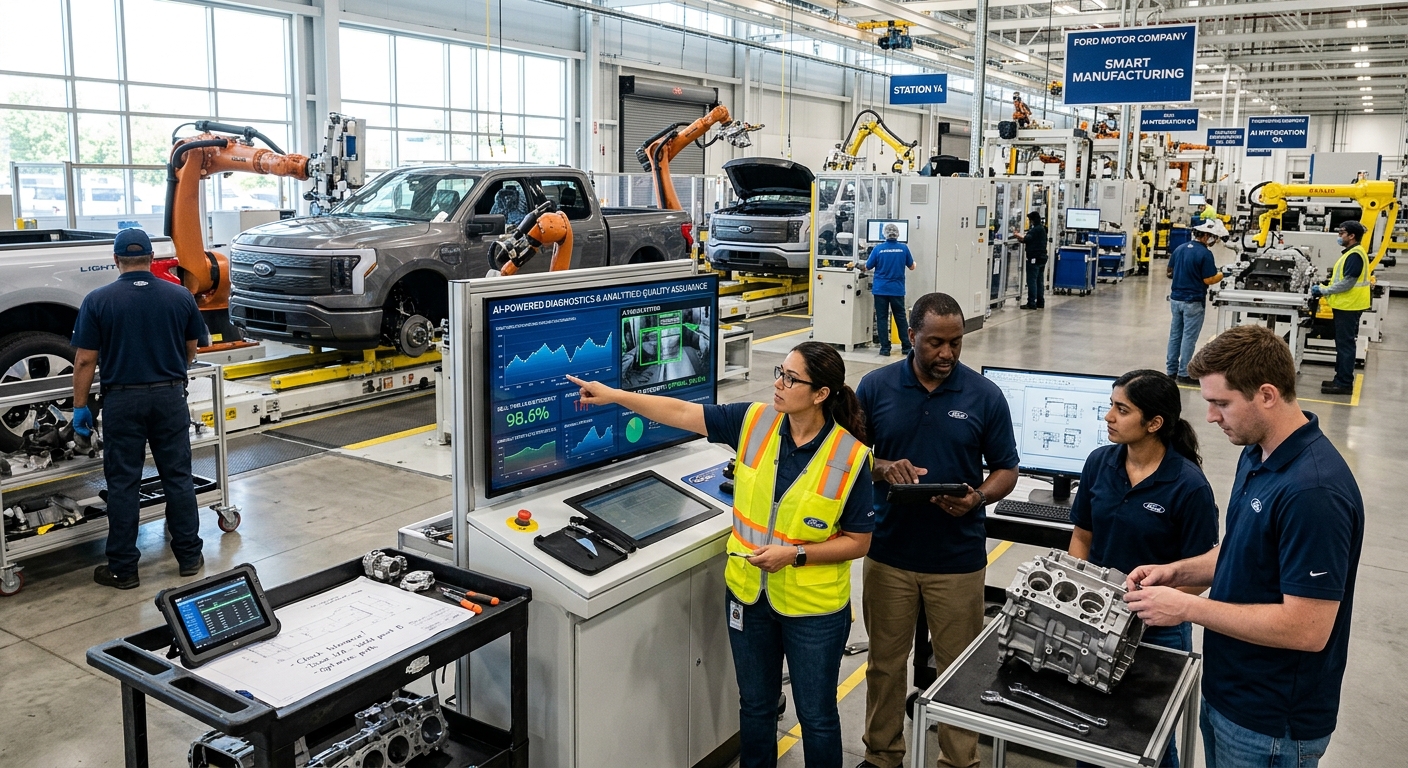
The rehiring effort aimed to rebuild a critical layer of expertise within the company by bringing back over 350 seasoned engineers. These engineers not only mentored younger staff members who were struggling with maintaining vehicle quality but also worked on enhancing data collection and artificial intelligence (AI) training that underpin Ford’s automated systems. This approach reflects Ford’s broader commitment to integrating AI and advanced diagnostic workflows, as exemplified by the deployment of in-house AI systems such as AiTriz and MAIVS, designed to detect factory defects in real time with high precision.
Ford’s initiative to combine human expertise with evolving AI technologies highlights the complexities and challenges faced in maintaining high-quality standards in an era increasingly dominated by automation. The company’s efforts to rehire experienced personnel and invest in advanced AI-driven diagnostic tools illustrate a comprehensive response to overcoming the limitations found in their automated manufacturing environment.
Rehiring of Former Engineers
In response to challenges encountered in maintaining and advancing its automated systems, Ford has undertaken a strategic initiative to rehire former engineers with extensive experience in vehicle engineering, manufacturing, and supply-chain operations. This effort aims to blend the agility of software development with the stringent validation requirements characteristic of automotive-grade engineering. Over 350 experienced engineers have been rehired, promoted, or brought back to rebuild critical layers of expertise within the company. These veterans not only mentor younger engineers struggling to uphold vehicle quality but also lead improvements in data collection and AI training processes fundamental to Ford’s automation systems.
The rehiring strategy reflects a broader trend in the tech and automotive industries, often referred to as “boomerang hiring,” wherein companies recognize the indispensability of human insight in managing AI’s limitations and complexities. While AI automates routine tasks, the nuanced nature of software development and system integration demands seasoned professionals capable of overseeing these processes effectively. Ford’s approach aligns with this understanding, leveraging the knowledge of former employees to enhance the reliability and performance of its intelligent diagnostic workflows and production validation procedures.
This rehiring initiative also addresses the regulatory and technical challenges associated with evolving industry standards. Former engineers with deep domain expertise are essential to navigate these complexities, particularly in environments requiring strict compliance such as manufacturing and automotive sectors. Their return helps ensure that automated systems—ranging from controls and robotic welding to augmented reality-assisted repairs—function efficiently and safely, thereby supporting both operational excellence and innovation.
Ford’s commitment to reintegrating skilled personnel underscores the company’s recognition that effective automation depends on a symbiotic relationship between advanced AI technologies and human expertise. This fusion is critical to sustaining quality and driving continuous improvement within Ford’s production ecosystem.
Identified Flaws in Automated Systems
Ford has encountered significant challenges with the robustness of its automated systems, revealing that these systems were not as reliable as initially assumed. The company discovered that its automated processes were generating errors that required intervention by experienced technicians, prompting Ford to rehire former employees to address and correct these flaws. These issues underscored the limitations of Ford’s earlier automation strategies, which did not fully capitalize on rapid software iteration cycles, resulting in software bugs being detected only late in the development process.
The impact of these automated system flaws has been costly and far-reaching. For example, recall campaigns driven by system-related issues have led to substantial financial burdens; one notable instance involved a fuel leak recall affecting 694,271 Bronco Sport and Escape SUVs, with estimated costs reaching $570 million. Furthermore, system faults such as communication losses in trucks, vans, and SUVs manufactured between 2021 and 2026 have led to critical safety warnings, including malfunctioning trailer brake modules and blind spot assist systems, which compromise vehicle safety and driver awareness.
In addition to manufacturing and product quality concerns, automation errors have extended into human resources processes. An example includes the failure to properly manage return-to-office email communications, where automated warning emails erroneously flagged compliant employees with threatening termination notices. Ford’s HR leadership publicly acknowledged these communication errors and pledged corrective measures after employees were caught in this system malfunction.
These identified flaws have demonstrated the complexity of integrating AI and automation into automotive manufacturing and corporate operations. They highlight the need for rigorous validation and real-time monitoring to ensure system reliability and prevent costly or unsafe outcomes. In response, Ford has significantly expanded its AI-powered automated testing capabilities, adding over 100,000 new tests designed to detect edge cases and stress software under varied conditions, reflecting a commitment to strengthening these systems going forward.
Remediation Efforts and Technical Solutions
Ford has embarked on extensive remediation efforts to address the quality and performance issues in its automated systems. Central to these efforts is a cultural shift within the company, where accountability is emphasized across all levels of management—from engineering managers to plant managers and component purchasing leads. This end-to-end transformation involves overhauling the supply chain, manufacturing processes, engineering systems, and testing methodologies, with a strong focus on root-cause analysis and cross-disciplinary problem solving.
To bolster its technical capabilities, Ford has rehired experienced former engineers and leveraged their expertise to improve data collection and AI training underpinning the company’s automated diagnostic systems. These seasoned engineers play a critical role in identifying and resolving emerging issues before they escalate, addressing challenges that range from software stress testing to complex failure simulations. Ford has dramatically expanded its automated testing regime by adding over 100,000 AI-powered tests designed to identify edge cases and stress software systems under diverse operating conditions.
A key technical advancement in Ford’s approach is the integration of AI-powered diagnostic workflows. These workflows harness vehicle signals such as Diagnostic Trouble Codes (DTCs), Parameter IDs (PIDs), and Ethernet logs combined with large language model (LLM)-based reasoning to automate root-cause isolation. This “Intelligence Loop” enhances the accuracy and efficiency of fault detection, enabling engineers to validate system integrations through rigorous production validation and simulated failure scenarios.
Ford also applies a modular design philosophy, supported by systems engineering principles, to streamline product development and reduce errors. Instead of building vehicles from the ground up, engineers select from a modular catalogue featuring over 130 modules and 20+ variants, ensuring components fit together seamlessly when assembled. This modular approach has benefited from advanced training such as Model-Based Systems Engineering, which improves development cycle efficiency and minimizes complexity-related errors.
While these technical measures are critical, Ford recognizes the need to extend remediation beyond engineering. The company is addressing organizational culture and feedback mechanisms, including its “SpeakUp” program, to protect employees and foster an environment that identifies and retains talent rather than perpetuating systemic flaws. Despite the challenges posed by regulatory complexity and workforce transitions such as rehiring retirees or outsourcing expertise, Ford’s holistic strategy aims to create sustainable improvements in quality and cost management across the industrial system.
Finally, Ford acknowledges the dual-edged nature of AI and automation technologies. While AI enhances repair processes and system diagnostics, it also disrupts labor markets, leading to concerns about job displacement and economic impact. The company’s efforts to mature intelligent diagnostic workflows reflect a balance between technological innovation and practical, human-centered application.
Outcomes and Measurable Impacts
Ford’s decision to rehire former engineers and experienced technicians to address flaws in its automated manufacturing systems has led to several notable outcomes. The company recognized that its earlier reliance on automation had not met expectations, with automated systems proving less robust than anticipated. This necessitated bringing back skilled personnel to correct errors generated by robotic processes and to enhance overall production quality.
One measurable impact has been the implementation of advanced AI-supported vision systems across numerous manufacturing stations in North America. Technologies such as AiTriz and MAIVS are now deployed at 35 and nearly 700 stations respectively, enabling real-time detection and correction of assembly errors. These systems have contributed significantly to reducing costly defects and improving production efficiency by allowing immediate fixes before the vehicles proceed further down the assembly line.
Despite these technological advancements, Ford continues to face challenges related to vehicle recalls. The company has led the automotive industry in recall numbers for four of the past five years, with costly recalls such as the fuel leak issue affecting 694,271 Bronco Sport and Escape SUVs, estimated to cost $570 million. These recalls highlight ongoing quality control difficulties and underscore the financial and reputational impacts of earlier management and system shortcomings.
In response, Ford is also undertaking a comprehensive overhaul of its legacy systems by developing a state-of-the-art End-to-End (E2E) Software Diagnostics & Observability platform. This intelligent pipeline integrates embedded telemetry, cloud data lakes, and AI reasoning engines to proactively identify and resolve complex vehicle issues before they reach customers. The initiative represents a cultural shift toward accountability and performance-based quality management across all levels of the company, aiming to reduce defects and recall rates over the coming years.
Company Response and Public Perception
In response to ongoing quality issues and costly recalls, Ford Motor Company has undertaken significant efforts to address and improve its management systems and related business processes. CEO Jim Farley has made fixing quality the company’s top priority, emphasizing that this initiative is the most important across the entire organization. Since officially taking the helm in October 2020, Farley has been on a multi-year mission to enhance product quality, acknowledging that progress remains a work in progress.
Part of Ford’s strategy involves fostering a culture shift within the company where accountability for quality and cost is placed directly on engineering managers, purchasing component managers, and plant managers. This performance reward system aims to ensure that every level of management is invested in quality outcomes. Additionally, Ford has initiated continuous improvement programs targeting systemic flaws in automated systems and engineering processes.
To bolster these efforts, Ford has engaged in “boomerang hiring,” a practice that involves rehiring former employees—particularly engineers—with the specialized knowledge required to navigate and rectify complexities in automated systems. This approach reflects a broader industry trend where companies seek experienced talent familiar with internal processes to accelerate quality improvements and mitigate past issues.
Public perception of Ford’s quality challenges has been mixed, as repeated recalls have not only damaged the company’s reputation but also incurred substantial financial costs. Nonetheless, the company’s transparent commitment to fixing these problems and its investment in culture and talent reforms have been viewed as positive steps toward restoring confidence among consumers and stakeholders.
Comparison with Industry Practices
Ford’s approach to rehiring former engineers to address shortcomings in its automated systems reflects a broader trend observed across various industries, where organizations increasingly recognize the critical value of institutional knowledge and human expertise in the age of automation and AI. Unlike some sectors that primarily rely on outsourcing or rehiring retirees—practices that can elevate costs and complicate knowledge transfer—Ford’s strategy emphasizes reintegrating experienced personnel to directly mentor younger engineers and improve AI training processes.
In manufacturing and high-tech industries, regulatory complexity and the need for adherence to evolving standards make the retention and transfer of expertise essential. For example, automation engineers in sectors such as semiconductor, pharmaceutical, and automotive manufacturing play vital roles in maintaining 24/7 operations, underscoring the importance of experienced staff in sustaining quality and compliance. Ford’s challenges mirror these dynamics, particularly as its veteran engineers’ deep understanding of vehicle development cycles has proven indispensable in refining AI-driven quality control systems.
The tech industry’s phenomenon of “boomerang hiring”—where companies bring back former employees to leverage their unique insights in navigating AI’s limitations—parallels Ford’s rehiring efforts. This approach acknowledges that while AI can automate routine tasks, human judgment remains crucial in addressing complex problems and preventing systemic failures. Ford’s experience highlights the risks of undervaluing institutional knowledge, as premature departures of seasoned engineers led to quality declines and necessitated their return to mentor staff and recalibrate AI models.
Influence on Innovation and Competitive Position
Ford’s strategy of rehiring former engineers, known as “boomerang hiring,” has played a pivotal role in addressing flaws within its automated systems while simultaneously influencing the company’s innovation trajectory and competitive stance. By bringing back experienced personnel familiar with the company’s technologies and culture, Ford is leveraging institutional knowledge to navigate the complexities of integrating advanced technologies such as artificial intelligence and machine learning into its vehicle lineup.
This rehiring trend reflects broader shifts in the automotive industry, where rapid advancements in electric and smart vehicle technologies have rendered some traditional engineering roles obsolete while increasing demand for senior developers capable of managing AI-driven innovations. Ford’s emphasis on over-the-air (OTA) software updates exemplifies this transformation, enabling the company to quickly and wirelessly upgrade vehicles to maintain technological currency and reduce repair visits. The expertise of returning engineers has been instrumental in developing such capabilities, directly impacting the company’s ability to stay competitive in a fast-evolving market.
Furthermore, the focus on innovation extends beyond technology to workforce diversity and mentorship, with Ford highlighting the importance of female mentorship in engineering roles. Such initiatives foster a culture conducive to creative problem-solving and inclusive idea generation, essential for producing well-rounded solutions that meet diverse customer needs.
However, Ford faces significant challenges amid this transition. The reduction in work related to internal combustion engine drivetrains has led to job vulnerabilities in certain engineering areas, necessitating a recalibration of skills toward electric and automated vehicle platforms. This shift has resulted in layoffs primarily in administration, product development, and production sectors, underscoring the company’s efforts to realign its resources with emerging priorities.
In sum, Ford’s approach to rehiring experienced engineers not only remedies immediate technical flaws but also strengthens its innovation capabilities and competitive positioning by fostering agile development processes, embracing advanced software solutions, and promoting a diverse and skilled workforce attuned to the demands of the future automotive landscape.
Future Directions
Ford’s approach to addressing the flaws in its automated systems underscores a broader trend of leveraging experienced talent to navigate the complexities of
The content is provided by Avery Redwood, 9 Minute Read