
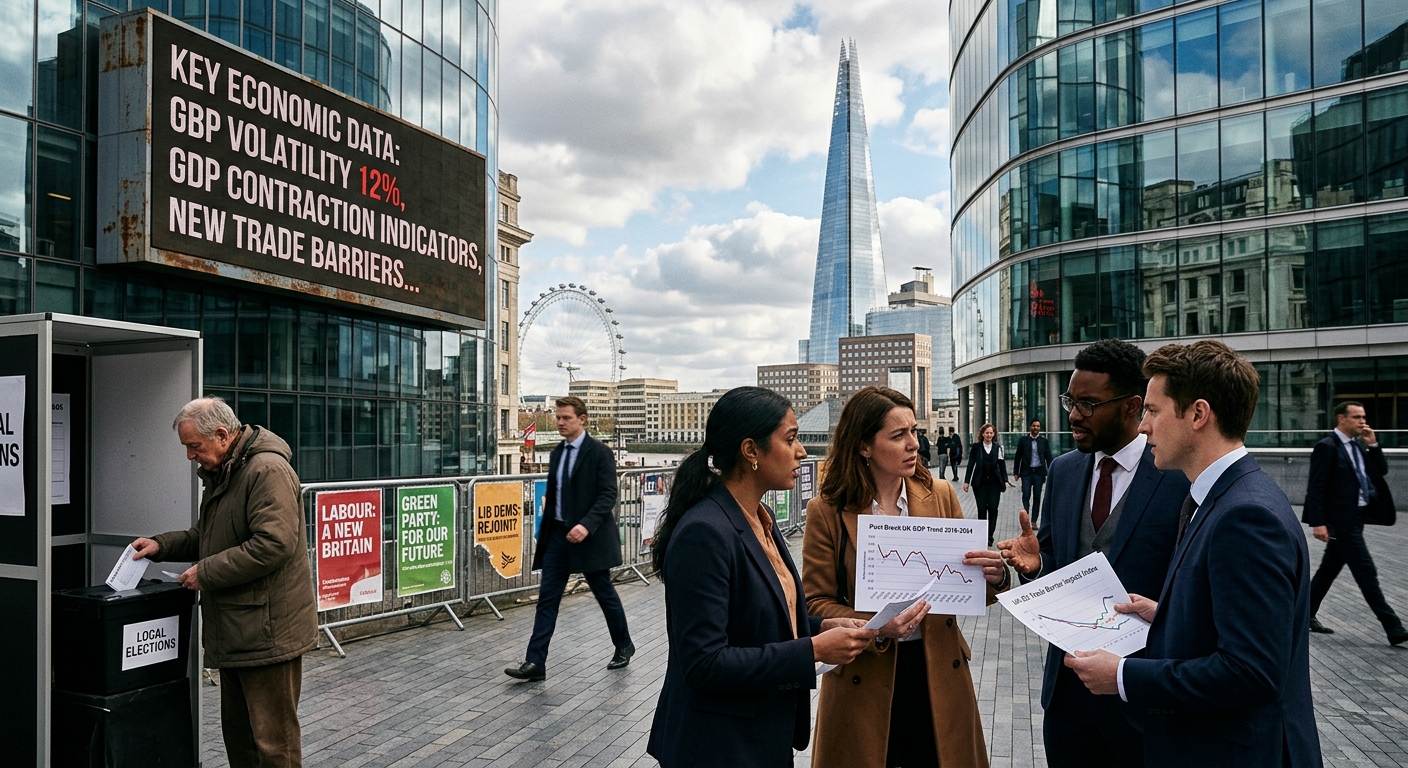
Summary of Brexit’s Impact
Brexit, the United Kingdom’s departure from the European Union, has instigated significant economic and political shifts since the 2016 referendum. Officially leaving on January 31, 2020, the UK navigated a transition period that brought about the UK-EU Trade and Cooperation Agreement (TCA), introducing new trade barriers that reshaped economic dynamics and reduced business investment. Consequently, UK GDP has contracted relative to expected growth, highlighting challenges in key sectors like financial services and construction that are struggling with market access and labor shortages, ultimately affecting regional productivity and economic growth.
The Economic Fallout
Post-Brexit, the UK has faced substantial economic changes resulting from newly imposed trade barriers. While initial trade flows remained stable, the TCA implementation marked a notable slowdown in UK goods exports, particularly affecting those industries tightly linked to the EU market. This shift has resulted in a decline in trade volumes, reduced business investment, and a drop in GDP, exacerbating existing disparities and leaving the economy less dynamic than projected.
Shifts in Political Landscape
Brexit has catalyzed a realignment within UK politics, significantly altering voter behavior and diminishing the traditional power of the Conservative and Labour parties. The emergence of nationalist parties, particularly in Scotland, Wales, and Northern Ireland, has introduced new complexities in governance and intergovernmental relations. The Labour Party’s recent electoral success further reflects the shifting political sentiments, emphasizing the ongoing fragmentation within the electorate.
Data Visualization and Understanding Change
Charts and data visualization have been essential in interpreting the multifaceted implications of Brexit. Visual tools simplify the complex economic data and trends surrounding unemployment, trade patterns, and productivity, facilitating a better understanding of shifts in both public sentiment and political dynamics. The use of these graphical tools enhances accessibility for stakeholders and aids in evaluating economic health and sector-specific outcomes post-Brexit.
Case Studies of Sectoral Impacts
Financial Services
The financial services sector has navigated significant upheaval since Brexit, with some jobs migrating to other financial hubs in Europe due to diminished access to the EU market. While the sector remains a pivotal part of the economy, overall job stability has masked underlying challenges. Adapting to new data collection methods is now crucial for tracking industry performance amidst evolving market conditions.
Construction Challenges
The construction industry has felt the pinch from Brexit through material cost increases and a reduction in available labor. The loss of EU workers has created significant skill shortages, prompting companies to pivot toward local recruitment strategies. Additionally, post-Brexit regulations have added layers of complexity to compliance, reshaping operational norms within the industry.
Regional Economic Disparities
The regional economic effects of Brexit have been uneven, with areas reliant on EU trade encountering the most significant setbacks. Cities like London have reported severe job losses and declining living standards as a result of diminished economic activity. As the economy restructures, strategies to address these regional inequalities become crucial to fostering balanced growth.
Trade Dynamics
Since transitioning out of the EU, UK goods exports have decreased relative to those of other G7 nations, largely due to trade frictions exacerbated by the TCA. Although service exports have remained resilient, overall economic size and trade patterns suggest a negative long-term impact from Brexit, necessitating a reevaluation of the UK’s global trade relations.
Public Perception and Political Sentiment
Public perception and media representations since Brexit continue to shape understanding of the UK’s evolving political and economic landscape. The discourse around government policies and political fragmentation underscores widespread voter dissatisfaction and reflects a shift away from established party loyalties.
Future Considerations
The future landscape for the UK is marked by emerging opportunities alongside persistent challenges stemming from Brexit. Economic forecasts indicate potential growth, though long-term productivity and investment concerns remain crucial. Politically, the potential rise of new parties and tensions between devolved governments may further complicate governance and national policy coherence. In navigating this complex climate, adaptive strategies and collaboration across all levels of government will be essential in addressing both economic and social transitions going forward.
The content is provided by Blake Sterling, 9 Minute Read