
Summary
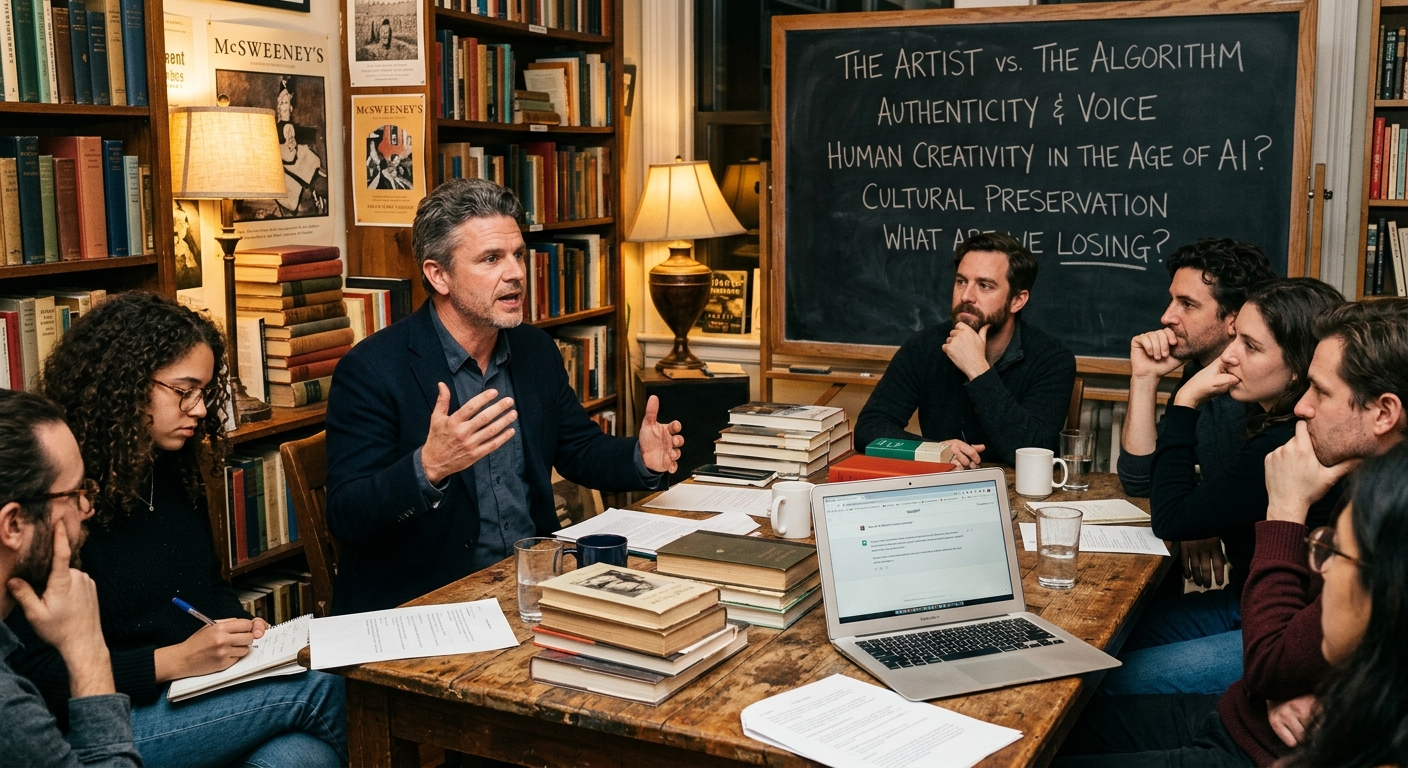
Dave Eggers, an acclaimed writer and artist known for his exploration of technology’s impact on society, has emerged as a vocal critic of artificial intelligence (AI) tools like OpenAI’s ChatGPT, warning that such technologies risk silencing a whole generation by undermining human creativity and original expression. Drawing on his experience in education and the arts, Eggers argues that AI-generated content cannot replicate the emotional depth and individuality inherent to human-created art, which he views as essential to cultural and personal identity. His concerns highlight the growing tension between technological innovation and the preservation of authentic human voice amid AI’s expanding role in creative and educational contexts.
Eggers’s critique is particularly focused on the implications of AI in classrooms, where he observes that tools like ChatGPT add substantial burdens to educators and threaten to erode students’ ability to develop original thought and writing skills. He has publicly engaged with OpenAI’s leadership to discuss these challenges, emphasizing that AI’s facilitation of idea generation and writing may lead to a diminished creative capacity among young people, a phenomenon he describes as “apocalyptic” for education. Furthermore, Eggers and his wife have taken legal action against AI companies for unauthorized use of their literary works in training language models, underscoring the ethical and legal controversies surrounding AI’s use of copyrighted material.
Eggers’s warnings intersect with broader debates on the societal and cultural effects of generative AI, including concerns about privacy, social inequality, and the authenticity of AI-produced content. His stance has provoked discussions about the role of AI content moderation and freedom of expression, as platforms like OpenAI seek to balance safeguarding users while fostering open dialogue. Through public advocacy and participation in ongoing legal and policy debates, Eggers represents a prominent voice cautioning against uncritical acceptance of AI’s encroachment on creative and educational domains.
In sum, Dave Eggers’s engagement with OpenAI and critiques of ChatGPT illuminate the risks AI poses to nurturing human originality and preserving the cultural significance of art and literature. His perspective calls for careful consideration of how AI technologies are integrated into society to ensure they complement rather than replace the uniquely human processes of creativity and storytelling.
Background
Dave Eggers, a prominent writer and visual artist, has long emphasized the value of human creativity and the artistic process. His latest novel, Contrapposto, which he has been contemplating for nearly two decades, explores themes of friendship and artistic collaboration, reflecting his belief that many artists produce their best work later in life, often in their 80s and 90s. Eggers himself maintains a low-tech lifestyle, preferring traditional methods such as life drawing and writing with pencil and paper, and he expresses skepticism about the creative capabilities of artificial intelligence, asserting that “only humans can create art,” while AI-generated content amounts merely to “computer generated imagery”.
Eggers’s concerns extend beyond the artistic domain into broader societal issues related to technology and privacy. Living in San Francisco, he is wary of pervasive surveillance technologies and actively resists participating in systems that compromise privacy, such as Ubers equipped with recording devices. Nevertheless, he remains cautiously optimistic about grassroots efforts, like well-crafted ballot measures, that could protect civil liberties in an increasingly monitored city.
As AI tools like ChatGPT, developed by OpenAI, gain prominence for their ability to generate text and images through advanced language models, Eggers views their impact on creativity and education with mixed feelings. While he acknowledges the integration of technology in educational settings—such as the use of laptops for essay composition at writing centers—he worries that such technologies might dampen the creative spirit that human-led initiatives strive to nurture. His perspective resonates with broader debates on AI’s societal implications, including concerns about privacy, social inequality, and the authenticity of AI-generated content.
In this context, Eggers has reportedly warned the OpenAI team that tools like ChatGPT risk silencing an entire generation of creators by undermining the value of human originality and expression. This stance underscores his broader conviction that while AI may assist with certain tasks, it cannot replace the uniquely human capacity for artistic creation and the nuanced storytelling that defines meaningful literature.
Dave Eggers’s Views on AI
Dave Eggers has expressed deep concerns about the impact of artificial intelligence on creativity, education, and personal expression. Known for his dystopian novels The Circle (2013) and The Every (2021), which explore themes of technological dominance and surveillance, Eggers has remarked that reality increasingly outpaces even his imagination regarding technology’s influence on human life.
Eggers strongly opposes the use of AI to replace or mimic genuine human creativity, stating, “Only humans can create art,” and dismissing AI-generated works as mere “computer generated imagery” rather than true artistic expression. He views the reliance on AI for creative processes—such as writing or art—as a betrayal of individual voice, calling it “such a crime against yourself” to let machines speak or create for you. For Eggers, creativity is a deeply personal and evolving trait that enriches over time, sometimes peaking in later decades of life, and must be cultivated thoughtfully, especially in an AI-driven world.
Eggers also highlights the challenges AI poses in educational settings. Drawing on his extensive experience working with children, he notes that AI introduces unprecedented difficulties, including the blurred lines students draw between using AI to generate ideas and actually creating original work. He criticizes policymakers who promote early AI adoption in schools without fully understanding the implications, citing the US education secretary’s mispronunciation of “AI” as indicative of misplaced leadership in this area.
Moreover, Eggers has engaged directly with leaders in AI development, including a recent invitation by OpenAI’s Sam Altman to discuss AI-written novels. He emphasizes the existential threat AI represents to authentic creativity and the broader cultural fabric. Despite the grim outlook, Eggers remains hopeful that a countermovement will emerge, akin to the current resistance against early social media use among teenagers, encouraging a renewed appreciation for human originality and deliberate artistry.
Public Engagements and Interactions with OpenAI
Dave Eggers has been an outspoken critic and active participant in discussions surrounding the impact of AI technologies like ChatGPT, particularly emphasizing their effects on education and creative development. He accepted an invitation from OpenAI CEO Sam Altman to speak at the company, where he candidly addressed the burden AI tools place on educators. Eggers highlighted that the introduction of ChatGPT is adding approximately 20 hours a week to the workload of every public school teacher in the United States, describing the effect as “apocalyptic” on young people’s ability to develop their own voice.
Eggers, a long-time volunteer at the after-school program 826 Valencia, has voiced concerns about economic barriers to creative education, criticizing the high costs of arts education programs such as MFA degrees and their role in perpetuating an “arts industrial complex” that stifles creativity and accessibility. He has also expressed skepticism toward policymakers’ understanding of AI’s impact on education, notably criticizing U.S. Education Secretary Linda McMahon’s enthusiasm for integrating AI in schools despite apparent misunderstandings about the technology. Eggers observes that while many teachers recognize the challenges AI presents in classrooms, the problem is compounded by a lack of informed policy.
He has highlighted a subtle but troubling trend among students who justify limited AI use—such as employing AI only to generate ideas rather than to write entire pieces—as still detrimental to the development of original thought. This concern underscores his broader argument that AI’s presence in educational settings threatens authentic creative growth and individual expression.
Eggers’s engagement extends beyond criticism to involvement in legal actions, as he and his wife, writer Vendela Vida, are participants in class action lawsuits against AI companies like Anthropic over unauthorized use of their literary works for training large language models. This involvement reflects his commitment to protecting creators’ rights in the evolving AI landscape.
Moreover, Eggers has been part of a community of users and commentators that formed out of frustration with AI moderation policies, seeking spaces where open, critical discussion about ChatGPT and AI content moderation can occur freely. His perspectives contribute to ongoing debates about the balance between content moderation and freedom of expression, a critical issue in AI governance that OpenAI continues to navigate.
Through these public engagements and interactions, Eggers has positioned himself as a prominent voice warning OpenAI and the broader AI community about the risks of silencing a generation’s creative potential through uncritical adoption and regulation of AI technologies.
Analysis of Claims about Silencing a Generation
Dave Eggers has expressed deep concern regarding the impact of AI tools like ChatGPT on human creativity and self-expression. He argues that relying on machines to articulate personal narratives or voices constitutes a profound loss, describing it as a “crime against yourself” and warning of a dystopian future where an entire generation might be tempted to cede their unique voices to AI intermediaries. According to Eggers, authentic art and creativity can only be produced by humans, while AI-generated content amounts merely to “computer generated imagery,” lacking the genuine human imagination and emotional depth that define true artistic expression.
Eggers emphasizes the importance of preserving spaces dedicated to “quiet creativity and analog creation,” advocating for refuges where individuality and originality can thrive without technological mediation. He stresses the pedagogical value of encouraging students to engage in handwritten work and personal expression, resisting the trend of outsourcing their voices to AI systems. This perspective highlights a broader cultural resistance against the automation of creativity and the dilution of human authorship.
These claims about AI silencing a generation intersect with ongoing debates about the societal implications of generative AI technologies. While AI tools like ChatGPT provide powerful capabilities for generating text, images, and speech, they also raise concerns about privacy, inequality, and the erosion of authentic human contribution. The controversy is compounded by critiques that AI development often builds upon centuries of human labor and creativity, yet its outputs are sometimes dismissed as economically worthless or undeserving of recognition, a stance Eggers characterizes as hypocritical.
Moreover, discussions around AI content moderation reflect tensions between ensuring safety and preserving open dialogue. OpenAI’s adjustments to moderation policies, influenced by public criticism and calls for less censorship, aim to balance ethical oversight with freedom of expression within AI-generated conversations. These dynamics add complexity to understanding how AI impacts individual and collective voices, reinforcing concerns like those raised by Eggers about potential silencing effects.
In sum, Eggers’s warnings about ChatGPT and similar AI tools spotlight the risk that overreliance on automated systems could suppress the development and transmission of authentic human voices, urging educators, creators, and society at large to cultivate environments that nurture human creativity beyond the reach of AI-generated substitutes.
Reactions and Interpretations
Dave Eggers has expressed deep concern about the impact of AI technologies, such as ChatGPT, on younger generations and educational environments. He warns that these tools risk silencing original thought and creativity among students, describing the AI challenge as “beyond an existential one.” Despite his extensive experience working with children, Eggers observes a troubling shift since the introduction of AI in classrooms, noting that even smart children often blur ethical boundaries by using AI not just for writing but to generate ideas, which he views as a far greater issue.
Eggers also criticizes policymakers for their apparent lack of understanding of AI’s implications. He highlights a speech by the US education secretary Linda McMahon, who advocated for the use of AI in schools, including for children as young as five, while repeatedly mispronouncing AI as “A-one.” Eggers uses this example to underscore his frustration with leadership on this issue, implying a disconnect between policymakers and the practical challenges faced by educators and students.
Beyond the educational sphere, Eggers and his wife, writer Vendela Vida, have engaged in legal action against Anthropic over unauthorized use of their books to train large language models, reflecting wider concerns about AI’s use of copyrighted materials.
While acknowledging the widespread concern about AI-generated content, Eggers anticipates the emergence of a counter-movement, analogous to existing resistance against teenage access to smartphones and social media. He believes that many teachers recognize the risks of integrating AI technologies too deeply into education and may play a crucial role in pushing back against unchecked AI adoption in schools.
OpenAI’s Position and Responses
OpenAI has publicly committed to addressing concerns related to the impact of its products, including ChatGPT, on users—especially minors and vulnerable individuals. Following investigations launched by a coalition of states into how OpenAI’s technologies affect users, the company stated that it takes these concerns seriously and aims to engage constructively with regulatory offices. An OpenAI spokesperson emphasized that the current version of ChatGPT incorporates a more protective experience for minors and people facing difficult situations by implementing safeguards that direct users to real-world resources and trusted human contacts.
Despite these commitments, OpenAI’s approach to content moderation and age verification has faced scrutiny. Reports indicate that initial plans for safeguarding younger users might have been developed with input from OpenAI’s own youth well-being experts, who reportedly oppose the roll-out in its current form. This has raised questions among parents about whether OpenAI truly heeds advice from its internal teams dedicated to youth safety. Additionally, the effectiveness of age checks has been challenged by the ease with which minors may circumvent age gates, potentially exposing them to inappropriate content. For instance, a bug discovered in April allowed minors to access graphic erotica on ChatGPT, though OpenAI subsequently fixed the issue following external testing.
In the broader context of content moderation, OpenAI aims to use its large language models (LLMs) like ChatGPT to tackle the complex “content moderation dilemma,” which involves managing user-generated content while balancing free expression and safety. This objective has attracted attention from advocates of Internet freedom and online speech regulation, given the critical role of content moderation in shaping online discourse. OpenAI’s efforts include conducting technical tests on ChatGPT and its GPTs service to refine moderation capabilities.
Nevertheless, concerns persist about the societal implications of generative AI tools, with debates encompassing privacy risks, potential social inequalities, and the broader impact on discourse. OpenAI’s public statements and ongoing development efforts reflect a recognition of these issues and a willingness to learn and adapt in response to stakeholder feedback.
Broader Cultural and Societal Implications
The advent of Generative AI tools such as ChatGPT has elicited widespread debate about their broader cultural and societal effects. While these technologies offer new opportunities for creativity and education, they also raise significant concerns about privacy, social inequality, and the transformation of creative industries.
Author Dave Eggers has been vocal about these challenges, particularly in the context of education. He highlights the tension between the potential benefits of AI in classrooms and the risks it poses to original thinking. Eggers notes that even young children are increasingly integrating AI into their learning processes, often blurring the line between idea generation and authorship, which he views as a profound challenge to educational integrity and creativity. This shift threatens to undermine the cultivation of unique, original thought, a cornerstone of both education and creative work.
Moreover, the cultural impact extends to the creative sector where AI-generated content is disrupting traditional livelihoods. Contrary to early hopes that AI might enhance human creativity, many creatives have experienced job losses or diminished income as consumers opt for cheaper AI-generated works, which Eggers critiques as inferior “slop” compared to human-made art and literature. This disruption prompts urgent discussions about the ethical use of AI in content creation and the preservation of artistic value.
Compounding these issues are debates surrounding content moderation and the balance between regulation and freedom of expression. As AI platforms like ChatGPT evolve, controversies have emerged over how content is filtered or censored, raising questions about the implications for open discourse and cultural diversity. Together, these factors underscore the complex and multifaceted societal implications of AI technologies, suggesting that their integration into daily life demands careful consideration of ethical, cultural, and educational dimensions.
The content is provided by Avery Redwood, 9 Minute Read