Summary
The Trump administration’s imposition of a $100,000 fee on certain new H-1B visa petitions marked a significant and contentious shift in U.S. immigration policy aimed at prioritizing higher-skilled and higher-wage foreign workers. Introduced as part of broader efforts to reform the H-1B visa program, the fee sought to discourage employers from sponsoring lower-paid foreign professionals and encourage hiring of American workers by increasing the financial cost of sponsorship. The policy generated widespread concern from employers, immigrant communities, and foreign governments, notably the Indian government, due to its potential to restrict access to the U.S. labor market for early-career and mid-level professionals.
The fee’s legality was vigorously challenged in federal courts, with opponents arguing it constituted an unauthorized tax imposed without congressional approval, violating constitutional and administrative law principles. In June 2025, a federal district court in Massachusetts ruled that the fee was effectively a tax rather than a permissible penalty or regulatory fee under the Immigration and Nationality Act (INA), and thus unlawful. The court vacated the fee entirely, emphasizing that the president lacked authority to impose such a tax absent explicit legislative authorization. This decision was supported by Supreme Court precedents limiting executive taxing powers without congressional delegation.
The Trump administration appealed the ruling, defending the fee as a lawful exercise of presidential authority under immigration statutes granting power to restrict entry of foreign nationals deemed detrimental to U.S. interests. The legal battle continued before the U.S. Courts of Appeals, with some courts upholding the fee and others vacating it, reflecting ongoing judicial division on the scope of executive power in immigration fee-setting. The dispute underscores the complexities of balancing immigration enforcement, labor market considerations, and separation of powers in U.S. immigration law.
Beyond the immediate legal controversy, the $100,000 fee’s introduction influenced employer hiring practices, prompting some companies to limit H-1B sponsorships to higher-wage or senior positions and leading foreign workers to explore alternative visa options. The policy’s uncertainty, coupled with concurrent fee increases for premium processing and changes in visa adjudications, continues to shape the evolving landscape of U.S. skilled worker immigration.
Background
The H-1B visa program is a widely used mechanism for U.S. employers, particularly in the technology sector, to hire highly skilled foreign professionals. Each year, the program grants 65,000 visas, with an additional 20,000 visas allocated for applicants holding advanced U.S. degrees. Traditionally, employers sponsoring H-1B workers paid government fees ranging from $2,000 to $5,000, while beneficiaries paid a $205 DS-160 application fee before attending visa interviews at U.S. embassies or consulates. Family members applying for H-4 visas are also required to pay their own DS-160 fees.
In recent years, the Trump administration implemented significant changes to the H-1B visa program, including the introduction of a controversial $100,000 fee intended to increase the cost of sponsorship for certain new H-1B petitions. This fee was part of an effort to encourage companies to hire more American workers by making it more expensive to sponsor foreign professionals, particularly in STEM fields. However, this additional fee raised concerns about accessibility for early-career workers, recent graduates, and industries with lower salary scales, potentially limiting U.S. work opportunities for these groups.
The administration also proposed a shift away from the existing random selection process for H-1B visas to a weighted system favoring higher-wage positions, alongside enhanced vetting procedures for applicants. These measures were justified under the Immigration and Nationality Act, which grants the president authority to impose restrictions on noncitizens deemed detrimental to U.S. interests.
Despite these changes, the $100,000 fee faced strong legal challenges. In June 2025, a federal district court in Massachusetts ruled that the fee was effectively a tax, which the president lacked authority to impose without Congressional approval, and vacated the policy. The court held that the fee was not a penalty but a tax, making its imposition unlawful under existing statutes. Multiple states, including California, along with various organizations, joined lawsuits arguing that the fee required legislative authorization, further contesting the administration’s approach.
While the Trump administration appealed the ruling and sought to reinstate the fee, courts remained divided on the issue. The legal battle underscored the complexities surrounding immigration policy, executive authority, and the impact of regulatory fees on the U.S. labor market.
Legal Challenges to the $100,000 Fee
The $100,000 fee imposed by the Trump administration on H-1B visa petitions faced multiple legal challenges soon after its announcement. The administration argued that the fee constituted a lawful monetary penalty authorized under federal immigration law, which grants the president the power to restrict entry of foreign nationals deemed “detrimental to the interests of the United States.” However, opponents contended that the fee functioned as a tax, which the president lacked congressional authorization to impose.
Several lawsuits were filed by a diverse group of plaintiffs including the U.S. Chamber of Commerce, Democratic-led states, religious organizations, labor unions, and employer coalitions. For example, the Chamber of Commerce challenged the fee on grounds that it exceeded the fee-setting authority granted by Congress and conflicted with federal immigration law. Similarly, a coalition of states and other groups filed suits asserting the fee was an unlawful tax requiring explicit legislative approval.
A critical ruling came from U.S. District Court Judge Leo Sorokin in Boston, who sided with twenty states and declared the visa policy unlawful. Judge Sorokin held that the $100,000 payment requirement was effectively a tax, not a penalty, and that imposing such a tax without clear congressional authorization violated both the Administrative Procedure Act and the Constitution. The ruling vacated the policy entirely, rather than limiting relief to the plaintiff states, and highlighted the lack of statutory delegation of taxing authority to the executive branch.
This decision was influenced by two Supreme Court precedents: the classification of the Affordable Care Act’s individual mandate as a tax, and a recent ruling rejecting President Trump’s unilateral imposition of global tariffs without clear congressional authorization. These cases underscored that taxing power requires explicit delegation by Congress, which was absent in the case of the H-1B fee.
The legal landscape remained complex, as other courts issued contrasting rulings, and several appeals were underway. The Chamber of Commerce, after suffering a loss in district court, sought to appeal the decision, and a U.S. appeals court agreed to expedite the appeal process. Meanwhile, the government filed a motion to stay Judge Sorokin’s order during the appeals process, leaving the fee’s immediate future uncertain. This patchwork of litigation suggested the possibility of divided appellate court rulings and further judicial review to definitively resolve the fee’s legality.
Appeals Court Decision
In a significant development, a U.S. appeals court agreed to expedite the appeal of a federal district court ruling that vacated the Trump Administration’s imposition of a $100,000 fee on new H-1B visa petitions for highly skilled foreign workers. The original decision, issued by U.S. District Judge Leo Sorokin, found that the administration lacked authority to impose the fee without congressional approval, concluding that the payment functioned as a tax rather than a lawful penalty or regulatory fee under the Immigration and Nationality Act (INA).
Judge Sorokin’s ruling relied on Supreme Court precedents that limit the president’s taxing authority without clear congressional authorization, notably referencing cases that upheld the Affordable Care Act’s individual mandate as a tax and rejected the president’s unilateral imposition of global tariffs. The court granted summary judgment for the plaintiff states, emphasizing that the fee exceeded the president’s authority and that agency implementation violated the Administrative Procedure Act (APA).
The plaintiffs, including California and nineteen other state attorneys general, argued that the fee was an unauthorized tax requiring legislative approval under the Constitution and the INA. While the district court’s decision vacated the fee entirely rather than restricting relief to the plaintiff states, the ruling remains subject to appeal before the 1st U.S. Circuit Court of Appeals. The government may seek a stay of the ruling pending appeal, and further appellate review is anticipated due to conflicting outcomes in related cases, such as the December 2025 ruling in Chamber of Commerce that upheld the fee.
The expedited appeal hearing before the U.S. Court of Appeals for the District of Columbia Circuit on March 9 highlighted the contentious nature of the issue, with plaintiffs seeking a declaration that the fee is an unlawful tax and opponents defending the president’s authority to impose it under the INA’s provisions granting power to restrict entry of foreign nationals deemed detrimental to U.S. interests. This ongoing legal battle underscores the complexities of presidential authority in immigration policy and the limits of executive power in imposing fees that function as taxes without explicit congressional consent.
Effects and Reactions
The proposed $100,000 fee on H-1B visa petitions, intended to prioritize higher-skilled and higher-paid applicants, elicited significant concern across multiple sectors. Nearly 65% of H-1B visa holders were engaged in computer-related jobs as of 2023, with over 70% being Indian citizens. This demographic concentration meant that the fee would disproportionately affect Indian professionals and their families, prompting the Indian Ministry of External Affairs to warn of potential “humanitarian consequences by way of the disruption caused for families” and urging the U.S. to address these impacts appropriately.
U.S. businesses, particularly those heavily reliant on skilled foreign labor, expressed alarm over the increased financial burden. The $100,000 charge was expected to be especially onerous for companies sponsoring many employees and for those operating in regions where demand for skilled professionals is high. Employers were reportedly caught off guard by the announcement and quickly mobilized communications and lobbying efforts to seek exemptions from the fee.
The Trump administration defended the measure as a mechanism to ensure that the H-1B visa program favored higher-skilled and higher-paid applicants while preserving opportunities at all wage levels. Officials framed the policy as a tool to protect American workers and maintain the nation’s global competitiveness in innovation. Nonetheless, critics argued that such policies, alongside increased scrutiny of student visa applications, risk undermining the U.S.’s standing as a global innovation leader by making it harder for talented individuals to enter the country.
Legally, the policy’s fate was contested. A D.C. District Judge upheld the President’s authority under immigration law to impose the fee, emphasizing congressional delegation of broad regulatory powers over nonimmigrant entry. The judge referenced a straightforward statutory reading supporting the executive action, despite prior Supreme Court rulings that limited the President’s authority to impose tariffs under emergency laws. Opponents, including the U.S. Chamber of Commerce, signaled intent to appeal the ruling, highlighting ongoing legal debates over the executive branch’s power to regulate visa fees and entry restrictions.
Implications for H-1B Visa Fee Structures and Employer Practices
The introduction of the $100,000 fee for certain H-1B visa petitions marked a significant shift in the cost structure associated with hiring foreign workers, particularly impacting employers and international professionals in STEM and other specialized fields. This fee was non-negotiable and specifically imposed on employers filing petitions requiring consular processing, while workers bore separate visa application costs. The policy aimed to prioritize higher-wage and higher-skilled roles by incentivizing employers to offer competitive salaries, with the visa selection system giving multiple entries to roles meeting higher wage thresholds as defined by the Bureau of Labor Statistics.
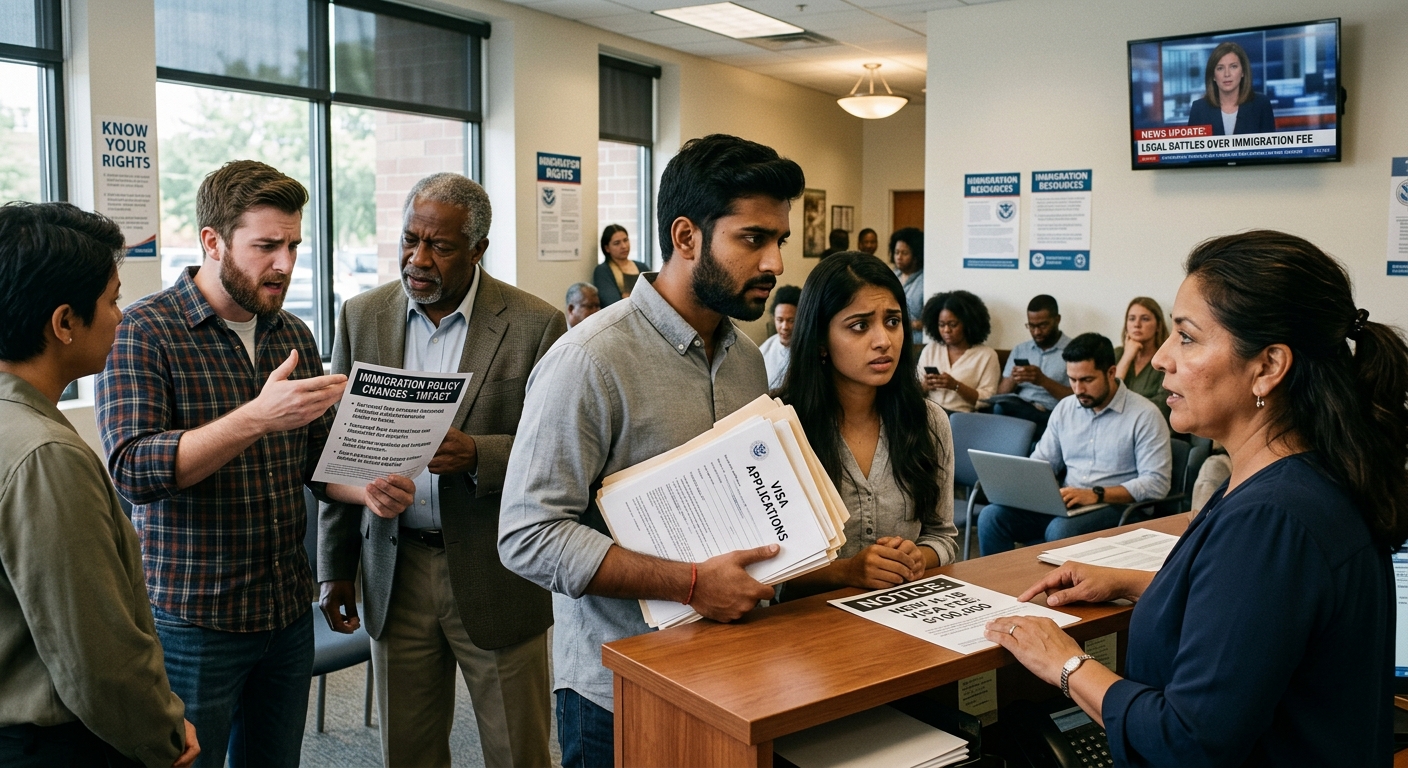
For U.S. employers, especially those sponsoring multiple employees or operating in sectors with high demand for skilled professionals, the increased fee presented substantial financial burdens. Companies faced the challenge of reassessing hiring strategies amid a landscape where early-career workers, recent graduates, and individuals from lower-paying industries might be excluded due to cost constraints. The fee effectively narrowed the pool of eligible foreign talent, compelling some employers to reserve H-1B sponsorships for senior or critical positions only.
International workers, particularly those on Optional Practical Training (OPT) seeking to transition to H-1B status, encountered a more selective and competitive job market as employers reconsidered their sponsorship approaches. This environment led to exploration of alternative visa pathways such as the O-1 extraordinary ability visa and EB-1A immigrant visa categories as potential options for foreign nationals.
The implementation of the fee also triggered significant legal challenges. Multiple lawsuits contested the fee’s legality, arguing that it constituted an unauthorized tax imposed without congressional approval. Courts in different jurisdictions issued conflicting rulings: a federal court in Washington, D.C., upheld the fee, affirming presidential authority to impose such financial requirements in the national interest, while a Massachusetts district court vacated the fee on grounds that the President lacked the delegated authority to levy such a tax. These rulings have created ongoing uncertainty for employers and applicants, with the ultimate status of the fee subject to appellate court decisions and potential policy revisions.
Given the uncertainty and operational difficulties caused by the fee and accompanying policies—such as the freeze on USCIS benefit processing for nationals of certain countries—employers have had to adopt cautious “hold-strategies” for deferred international hires while preparing petitions in readiness for any changes in the legal landscape. This careful approach aims to mitigate risks associated with costly filings that might be invalidated or delayed by court actions.
Subsequent Developments and Related Fee Changes
Following the legal challenges to the Trump administration’s $100,000 fee on new H-1B visas, several significant developments and related changes to USCIS fee structures have occurred. A U.S. appeals court agreed to expedite an appeal concerning the fee, reflecting ongoing judicial scrutiny and uncertainty regarding its future applicability. Multiple lawsuits have been filed by various groups, including religious and labor organizations, creating a complex legal landscape with potentially divergent appellate court decisions. One court vacated the fee policy entirely, though this ruling remains subject to further appeals and potential stays by the government, underscoring the unsettled status of the fee.
Concurrently, USCIS implemented notable increases to premium processing fees across various visa categories. As of February 26, 2024, the premium processing fee for Forms I-907 requesting H-2B or R-1 nonimmigrant classifications rose from $1,685 to $1,780, marking a 5.72 percent increase in line with the Consumer Price Index adjustments from June 2023 to June 2025. For all other eligible Form I-129 classifications—including E, H-1B, L, O, P, Q, and TN categories—the fee increased from $2,805 to $2,965, a $160 hike reflecting similar inflation adjustments. Prior to this, the premium processing fee for H-1B petitions had been raised from $2,500 to $2,805 in February 2024, while the H-1B registration fee remained steady at $10 for the Fiscal Year 2025 season.
These fees are charged upon receipt of the premium processing request and are partially refundable (50%) only if the prospective employee withdraws acceptance of the employment offer before the petition is submitted to USCIS; after submission, the fee becomes non-refundable. The evolving fee landscape and ongoing litigation illustrate the complex interplay between administrative fee adjustments and judicial oversight in U.S. immigration policy.
Legal and Policy Analysis
The legal controversy surrounding the $100,000 fee imposed on certain H-1B visa petitions centers on whether the fee constitutes a tax requiring explicit congressional authorization. Opponents, including California and nineteen other state attorneys general, argued that the Trump Administration lacked constitutional and statutory authority under the Immigration and Nationality Act to levy this fee, asserting it was effectively an unauthorized tax that must be enacted by legislation. A federal district court agreed, ruling the policy violated both the Administrative Procedure Act and the Constitution, and vacated the fee in its entirety rather than limiting relief to the plaintiff states.
The administration defended the fee as falling within the president’s broad authority over immigration policy, claiming the fee was justified by the determination of misuse within the H-1B visa program and that it aimed
The content is provided by Jordan Fields, 9 Minute Read