Summary
Join Mario in an Epic Barrel-Jumping Adventure with LEGO’s Donkey Kong Arcade Machine: Insights from Miyamoto
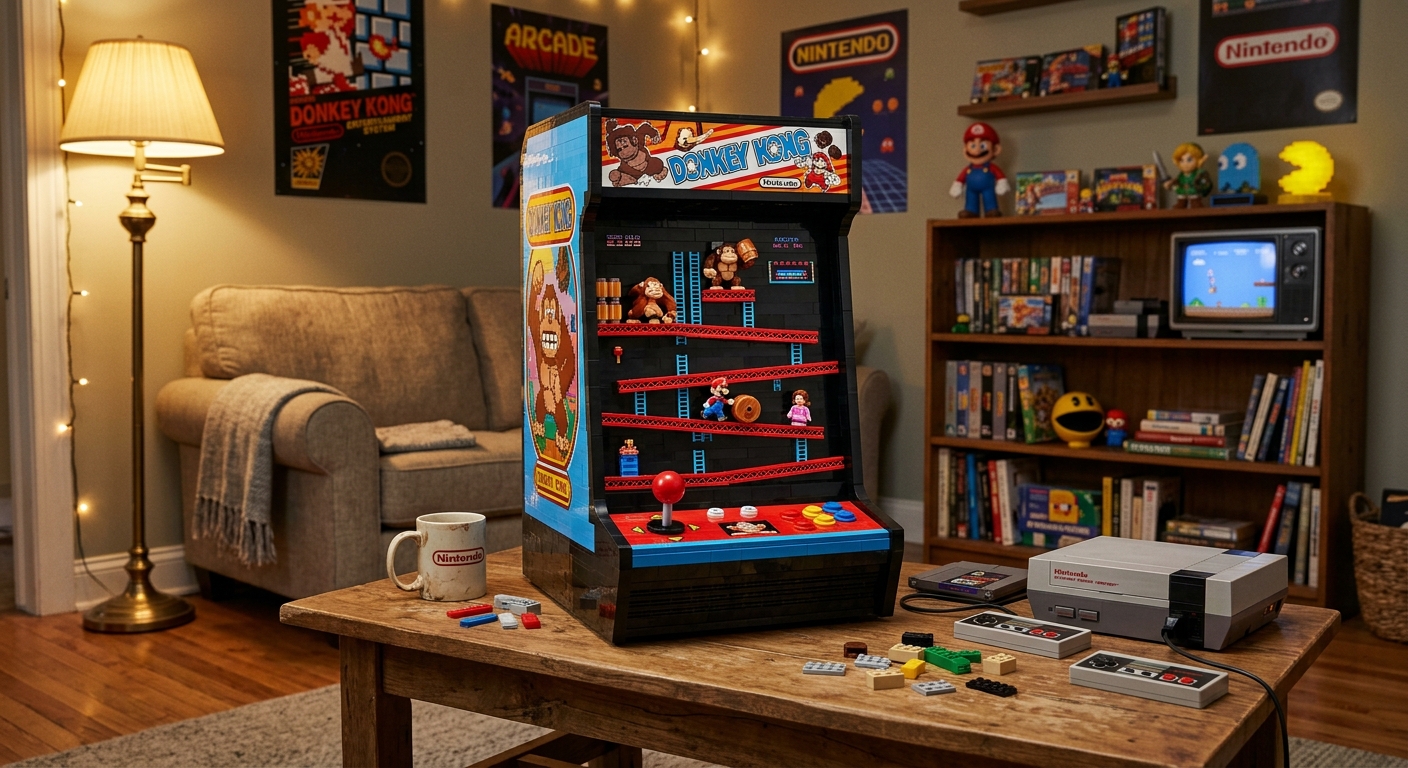
The LEGO Donkey Kong Arcade Machine is a highly detailed, interactive LEGO set that pays homage to the iconic 1981 Donkey Kong arcade game originally designed by Shigeru Miyamoto, often regarded as the “Father of Modern Video Games.” Scheduled for release on August 1, 2026, the set features 1,367 pieces and recreates the classic arcade cabinet experience with moving parts, including a joystick and buttons that allow players to control Mario (originally known as Jumpman) as he dodges barrels hurled by Donkey Kong to rescue Pauline. This collaboration between LEGO and Nintendo builds on the enduring legacy of Donkey Kong, one of the earliest platform games to combine narrative, gameplay innovation, and character-driven storytelling.
Donkey Kong’s development under Miyamoto marked a milestone in video game history, introducing the jump mechanic and multi-stage gameplay that shaped future gaming conventions. Miyamoto’s creative vision transformed a rejected concept into a groundbreaking arcade experience, blending influences from cartoons like Popeye with innovative mechanics such as sloped levels and barrel-throwing hazards. The LEGO set reflects these foundational elements, capturing the original’s aesthetic and gameplay in a physical, playable model that appeals to both nostalgic collectors and adult LEGO enthusiasts.
Designed by LEGO veteran Carl Merriam, known for his work on other nostalgic Nintendo sets, the Donkey Kong Arcade Machine incorporates advanced building techniques to achieve smooth mechanical functions and authentic visual details, including ladders, scaffolds, and iconic character minifigures. While limited by physical constraints, the set’s interactive features simulate the original game’s barrel-jumping challenge, offering an engaging experience that celebrates Donkey Kong’s cultural significance and lasting influence on gaming.
The LEGO Donkey Kong Arcade Machine not only serves as a tribute to a pioneering video game but also exemplifies the continued relevance of classic gaming through innovative collaborations. Its release coincides with the 45th anniversary of the original arcade debut, underscoring the enduring appeal of Miyamoto’s creation and its role in shaping the interactive entertainment landscape.
Background
The concept for the original Donkey Kong arcade game originated from plans that consisted of three A4-size sheets detailing the game’s content and characters, accompanied by sketches of game screens and a diagram of the final animation. These documents were stamped on March 30, 1980, by Nintendo’s creative section chief Shigeru Miyamoto, who played a pivotal role in the game’s development. Miyamoto, often hailed as the “Father of Modern Video Games,” is credited with creating several iconic franchises, including Donkey Kong and Mario.
Initially, Miyamoto gathered various ideas from Nintendo employees, but the original concepts, such as catapulting mechanics, were deemed too complex to program by his supervisor Gunpei Yokoi. After discarding these, Miyamoto devised the idea of sloped levels, multiple stages, and barrels hurled by Donkey Kong, which became a defining gameplay element. The game’s plot evolved from a loose adaptation of the Popeye cartoon characters: Olive Oyl was replaced by Lady (later known as Pauline), Donkey Kong took the place of Bluto, and the character based on Popeye transformed into Mario, initially known as Jumpman. The story centers on Donkey Kong escaping his master’s clutches, kidnapping Pauline, and climbing construction site girders, with Mario attempting to rescue her while dodging barrels thrown by Donkey Kong.
Donkey Kong was released in July 1981, despite early skepticism from Miyamoto’s team, and it quickly became Nintendo’s first major international success. The game’s popularity generated a $280 million windfall that rescued Nintendo of America from financial crisis and helped establish Nintendo as a prominent brand in the United States. The gameplay innovation included Mario’s jumping ability to evade barrels and use hammers as weapons, as well as the introduction of multiple stages and elaborate cutscenes, marking one of gaming’s first plots.
The enduring appeal of Donkey Kong has inspired modern tributes, such as the LEGO Donkey Kong Arcade set. This set, set to release on August 1, 2026, offers a detailed recreation of the original arcade game, including a level featuring Jumpman, Donkey Kong, and Lady, complete with scaffolds, ladders, hammers, and a mechanism to circulate barrels continuously. Players can pull a lever to release barrels and use a joystick to move Jumpman, simulating the jump-and-dodge gameplay of the original arcade classic.
Lego Adaptation
The LEGO 72051 Donkey Kong Arcade Machine is a meticulously crafted 1,367-piece set designed for adult builders aged 18 and above, set to release on August 1, 2026. Priced at $200, the set offers a relatively affordable entry point for collectors and fans, especially considering its elaborate design and functional elements. This model is part of LEGO’s ongoing collaboration with Nintendo, continuing their tradition of creating highly detailed and interactive sets that celebrate classic gaming franchises.
Unlike previous LEGO Nintendo sets, such as the NES model that featured a simple crank to scroll Mario through a level, the Donkey Kong Arcade set advances interactivity by incorporating moving parts that simulate gameplay. The set includes a joystick to move Mario (originally known as Jumpman) left and right, a button to make him jump, and a lever mechanism that releases barrels in a continuous loop, emulating the original arcade game’s barrel-throwing challenge. This playable feature allows builders to engage in a simplified but nostalgic barrel-jumping experience, capturing the spirit of the 1981 Donkey Kong arcade game designed by Shigeru Miyamoto himself.
Carl Merriam, a seasoned LEGO designer known for his work on nostalgic and complex builds such as the LEGO Nintendo Game Boy and Piranha Plant, played a pivotal role in developing this set. Merriam introduced innovative building techniques like the “Merriam’s Grate Inversion,” which enables smooth spinning of the capstan mechanism that releases barrels. His contributions helped balance aesthetic accuracy with functional mechanics, resulting in a model that is both a visually appealing display piece and a playable arcade machine.
The set features key characters from the original Donkey Kong game, including Jumpman (Mario), Donkey Kong, and Lady (later known as Pauline), alongside iconic elements such as scaffolds, ladders, and hammers. While the model includes numerous stickers for decoration, a departure from LEGO’s typical use of printed elements in their 18+ Nintendo sets, it remains faithful to the retro arcade aesthetic.
Gameplay and Mechanics
The LEGO Donkey Kong Arcade set recreates the classic 1981 arcade game by Shigeru Miyamoto with an interactive and playable model consisting of 1,367 pieces. The gameplay centers around controlling Jumpman (later known as Mario) as he navigates platforms to avoid obstacles such as barrels, fireballs, and gaps while attempting to rescue Pauline from Donkey Kong.
Players operate the model using a working joystick and buttons positioned at the base of the arcade cabinet. The joystick allows limited movement of Jumpman along the X and Y axes, enabling him to dodge barrels fed into the machine. A dedicated button makes Jumpman jump, employing a piano-key-inspired mechanism where pressing the button causes Jumpman to leap, and releasing it allows gravity to return him to the starting position. Another button is used to release barrels by pulling a lever, simulating the barrel-throwing challenge of the original game. The barrel mechanism cleverly stores a continuous loop of barrels and releases them one at a time, maintaining the gameplay flow.
The model stands approximately 15.5 inches tall and 10.5 inches wide when assembled, and it features detailed decorations including the iconic red “DONKEY KONG” lettering on top, scaffolds, ladders, and hammer details that replicate the arcade experience. Although the LEGO version does not allow Jumpman to complete the full climb to rescue Pauline, the set ingeniously captures the essence of the gameplay by combining mechanical elements and nostalgic design, making it both a display piece and an engaging interactive toy for fans aged 18 and above.
Development Team and Influences
The development of the Donkey Kong arcade game, which serves as the inspiration for the LEGO Donkey Kong Arcade Machine set, was spearheaded by Shigeru Miyamoto, a prominent figure in video game design. Born in Sonobe, Kyoto, Miyamoto initially pursued a career as a manga artist before turning his focus to video games. After joining Nintendo in 1977, he contributed to the arcade game Sheriff before being tasked with designing a new arcade game, leading to the creation of Donkey Kong in 1981.
Miyamoto’s approach combined his passion for comics and Japanese folklore with innovative gameplay mechanics and storytelling, pioneering narrative-driven games. Drawing inspiration from sources like “Beauty and the Beast,” American media including Popeye and King Kong, Miyamoto crafted a game that featured one of the first instances of a damsel in distress storyline, integrated multiple stages with unique challenges, and introduced the concept of jumping in platform games. His supervisor, Gunpei Yokoi, played a crucial role in refining Miyamoto’s concepts by advising on the technical feasibility of ideas such as catapulting and encouraging design elements like sloped levels, multi-stage gameplay, and the inclusion of barrels that Donkey Kong hurls at players.
In translating this classic game into a LEGO set, Carl Merriam, a LEGO designer known for nostalgia-inducing models like the LEGO Nintendo Game Boy and Piranha Plant, contributed significantly to the project. Merriam applied his expertise to balance authentic design with creative building techniques, such as the innovative Merriam’s Grate Inversion, which allows functional elements like the capstan to spin freely. The LEGO Donkey Kong Arcade Machine is a detailed homage to the original arcade cabinet, incorporating early character artwork and interactive features like a joystick and buttons that replicate the original gameplay experience, though limited by physical constraints—such as the inability to launch miniature barrels.
Together, the influences of Miyamoto’s storytelling and gameplay innovations, Yokoi’s technical guidance, and Merriam’s design craftsmanship have culminated in a LEGO set that both honors the historical significance of Donkey Kong and offers a nostalgic, collectible experience for fans of classic gaming and LEGO building.
Reception and Impact
The LEGO Donkey Kong Arcade Machine has been celebrated for its nostalgic and interactive design, capturing the essence of the original Donkey Kong arcade game. As a retro decor piece, it appeals to a wide audience, including adult fans of Donkey Kong and Super Mario franchises, serving both as a collectible and a functional gaming display that measures over 39 cm in height and incorporates play elements such as a joystick and lever to mimic the classic jump-and-dodge gameplay. Its design and concept breathe new creative life into old LEGO bricks, emphasizing sustainability while invoking fond memories of early arcade gaming.
The arcade game’s influence on gaming culture is deeply tied to Shigeru Miyamoto, the legendary Japanese game designer behind Donkey Kong and other iconic franchises. Miyamoto’s pioneering introduction of the jump mechanic in Donkey Kong was revolutionary at the time and helped shape the interactive play style that became a standard in video games. His creative vision transformed the arcade experience from simple entertainment into immersive, engaging worlds, a legacy that extends beyond arcades to home consoles, mobile games, and even theme park attractions.
Miyamoto’s work on Donkey Kong began after he joined Nintendo in 1977, initially aiming for a career as a manga artist before impressing the company president with his innovative toy designs. The game’s development involved overcoming multiple challenges, including creating a novel jumping mechanic that distinguished it from other games of the era. Furthermore, elements of the game, such as the rolling barrels, may have drawn inspiration from earlier cartoons, suggesting a cross-media influence acknowledged by Miyamoto himself.
Legacy and Cultural Significance
Donkey Kong, as one of the pioneering arcade games, marked a significant departure from the simple score-chasing mechanics of earlier titles by introducing a narrative-driven experience where players guided Mario—originally known as Jumpman—through hazardous platforms to rescue Pauline from the giant ape Donkey Kong. This early incorporation of storytelling, character-driven gameplay, and multiple stages set a new standard in the gaming industry, effectively creating one of gaming’s first plots. Shigeru Miyamoto’s creation of Mario as a character not only contributed to the game’s success but also laid the groundwork for one of the most iconic figures in video game history.
Miyamoto’s influence extends beyond Donkey Kong itself, shaping the arcade scene into a realm of creativity and interactive play. His visionary leadership helped Nintendo transition from arcade innovations to home consoles, mobile gaming, and even theme park attractions, demonstrating the adaptability and enduring appeal of his creations. Donkey Kong’s legacy is thus intertwined with the evolution of video games as a medium, influencing subsequent landmark titles such as Super Mario Bros. and The Legend of Zelda.
In contemporary culture, Donkey Kong continues to inspire new forms of engagement, such as the LEGO Donkey Kong Arcade Machine. This LEGO set not only faithfully recreates the original arcade machine with authentic details and interactive elements—allowing users to control Mario, navigate barrels, and experience the gameplay firsthand—but also serves as a nostalgic display piece celebrating the game’s historical significance. The collaboration between Nintendo and LEGO exemplifies how classic games like Donkey Kong maintain relevance by bridging generations of fans and creators, offering both a collectible for adults and a gateway for new audiences to appreciate the roots of video gaming culture.
Release Information
The LEGO Donkey Kong Arcade Machine is set to be released on August 1st, coinciding almost exactly with the 45th anniversary of the original Donkey Kong arcade game, which debuted in July 1981. Priced at $200 USD (also £150, €170, $270 CAD, or $280 AUD), the set is positioned as a collectible arcade game designed primarily for adult fans and LEGO enthusiasts.
This LEGO set stands out not only for its nostalgic appeal but also for its interactive features. It is a detailed recreation of the classic Donkey Kong arcade cabinet, featuring moving parts that allow players to actually control Mario (originally known as Jumpman) within the build. A joystick enables Mario to move across the levels, and a button makes him jump, replicating the core gameplay experience in LEGO form.
Initial details and images surfaced following a now-removed listing by UK retailer Argos, which prematurely revealed the set ahead of its official announcement. Despite the early removal, a video showcasing the set’s assembly and functionality has been widely shared, providing fans with a first look at what the LEGO Donkey Kong Arcade Machine offers.
The content is provided by Avery Redwood, 9 Minute Read