Summary
Kieran Hebden, widely known by his primary stage name Four Tet, is an influential British electronic music producer whose experimental side project—often identified by an unpronounceable string of glyphs resembling Wingdings—has garnered significant intrigue and acclaim since its inception around 2017. This enigmatic alias serves as a distinct artistic outlet separate from Hebden’s more polished Four Tet work, featuring a broad spectrum of luminous ambient textures, club-oriented grooves, and experimental pieces that span over two decades of his creative evolution. The project’s deliberate obscurity, including its use of unreadable symbols for artist and track names, challenges conventional norms in music presentation and DJ culture, positioning it as a notable exploration of identity and legibility in the digital age.
Emerging from Hebden’s extensive Spotify playlists and a desire to push artistic boundaries, the glyph project intertwines sonic innovation with visual abstraction, drawing on traditions of graphic notation and avant-garde experimentalism. Its releases reveal a raw, adventurous spirit reminiscent of 1990s left-field electronic music while simultaneously embracing contemporary digital aesthetics and rhythmic complexity. The cryptic nature of the project has fostered a cult following, with fans and critics alike praising its bold fusion of sound and symbol as well as its commentary on artificial intelligence and the fluidity of digital identity.
Despite its elusive presentation, the project has achieved notable visibility through streaming platforms, limited vinyl anthologies, and integration with Hebden’s broader discography, including the Four Tet album Parallel (2020). Tracks originally released under the glyph alias have influenced and appeared in related Hebden projects and live performances, further blurring the lines between his multiple musical personas. This fluidity exemplifies Hebden’s restless creativity and his commitment to innovation within and beyond electronic music.
Hebden’s glyph-based side project stands as a remarkable, secretive corner of his oeuvre that challenges traditional music consumption and production paradigms. It exemplifies an ongoing dialogue between sound, symbol, and technology, marking a unique contribution to contemporary electronic music and experimental art that continues to evolve with his artistic trajectory.
Background
Kieran Hebden, better known by his primary stage name Four Tet, is an influential electronic music producer and artist whose career spans over two decades. Born in Putney, London, in 1978 to a South African-born Indian mother and a British sociology lecturer father, Hebden developed his musical roots early on by forming the band Fridge during his school years at Elliott School, alongside Adem Ilhan and Sam Jeffers. The band signed a recording contract when Hebden was just 15, releasing their debut album Ceefax in 1997. Hebden’s solo breakthrough came with the 2003 album Rounds, which entered the UK album charts and earned critical acclaim, although it also inadvertently coined the term “folktronica,” a genre label he has often found limiting.
Parallel to his work as Four Tet, Hebden embarked on a mysterious side project beginning around 2017 under an unpronounceable alias composed of a bewildering string of glyphs resembling Wingdings characters. This cryptic pseudonym, which is effectively unreadable and can only be accessed through copy-pasting, served as a vehicle for releasing music that diverged from his more polished Four Tet material. The project originated from Hebden’s extensive Spotify playlist, which had grown to include over 2,300 songs and 192 hours of music by that time, with the playlist’s title itself rendered in a continuously changing string of Wingdings glyphs.
The music released under this glyph alias comprises a mix of luminous ambient textures, club grooves, and experimental pieces dating back more than twenty years. Some tracks have been identified as deep cuts from Four Tet’s back catalog, while others reveal a roughness and adventurous spirit reminiscent of the experimental electronic scenes of the 1990s. This side project presents a wide-angled portrait of Hebden’s creative practice, blending the exploratory ethos of his early days with his more recent polished productions. Fans and listeners familiar with Four Tet’s work often encounter an intriguing contrast between the sleekness of his main output and the rough, enigmatic quality of these glyph-based releases.
The project’s elusive nature and the complexity of its presentation—employing unprintable characters and a seemingly indecipherable language of symbols—have added to its mystique. Yet, it has become a testament to Hebden’s restless creativity and his interest in pushing the boundaries of electronic music and digital identity. In this way, the glyph project exists as a parallel universe within Hebden’s oeuvre, a “hole in the ice” where some of his most secretive and innovative work resides.
Project Overview
Kieran Hebden, widely recognized for his electronic music under the moniker Four Tet, embarked on a distinctive side project that stands out for its enigmatic presentation and experimental nature. This venture, often referred to by a string of unpronounceable glyphs resembling Wingdings, represents one of Hebden’s most intriguing artistic undertakings to date.
Conceived during a period of creative flux in 2020, this project followed Hebden’s eleventh studio album as Four Tet, Sixteen Oceans. It was developed amidst his continuous evolution from his early post-rock roots in the band Fridge towards increasingly digital, rhythmic, and genre-blending compositions incorporating folk, jazz, and hip-hop elements. The glyph-based alias and album titles employ a unique combination of symbols that appear indecipherable to computers and listeners alike, intentionally subverting the norms of music identification and presentation within DJ culture.
The project is often interpreted as an artistic commentary on the contemporary digital zeitgeist, especially regarding artificial intelligence and large language models (LLMs). By using cryptic glyphs as both the artist’s name and the titles of releases, Hebden challenges conventional notions of legibility, identity, and accessibility in music. This approach also aligns with broader experimental practices in notation and sound from the mid-20th century onwards, which sought to expand the boundaries of traditional musical expression.
Musically, the project spans a spectrum from luminous ambient textures to more energetic, club-oriented grooves, revealing a wide-angled portrait of Hebden’s creative practice over more than two decades. It revisits and reimagines the spirit of exploratory left-field music from the 1990s while simultaneously pushing forward into new, unknown territories of sound and form. Despite its obscurity and deliberate inaccessibility, the project has been recognized as housing some of Hebden’s most fully realized productions, cementing its place as a remarkable, secretive corner of his oeuvre.
Development and Production
Kieran Hebden’s extraordinary side project, often referred to by its distinctive glyph-based name, developed as an extension of his long-standing engagement with experimental sound and visual aesthetics. Since 2017, Hebden has gradually built a discography of loose tracks and EPs released under this alias, alongside other pseudonyms such as 00110100 01010100, which produced the albums 0181 and 871. This body of work initially circulated in a somewhat secretive manner, with several tracks appearing before more formal releases, such as those that surfaced on the Four Tet album Parallel in 2020.
The project’s production reflects Hebden’s signature style, maintaining his mastery of the Four Tet sound while exploring more dance-oriented textures and rhythms, notably leaning towards club-friendly outputs. Several tracks from this side project had been previewed or released through other channels, including one track performed by Fred Again during a Boiler Room set under yet another Hebden alias, KH. This interconnected release strategy emphasizes both the experimental and communal aspects of the work.
The use of glyphs and unconventional graphic elements in the project’s naming and presentation aligns with broader traditions in experimental music notation and graphic scores, where composers employ shapes and visual patterns to inspire performers and challenge conventional music writing. Hebden’s project, therefore, not only advances his musical explorations but also participates in an artistic lineage that dates back to mid-20th-century experimental practices and the Fluxus movement, which valued participatory and deprofessionalized approaches to music-making.
As the project has become more widely accessible, with many tracks accumulating millions of plays on streaming platforms like Spotify, it has shed some of its initial secrecy, making navigation and discovery easier for listeners intrigued by its unique aesthetic and sound palette.
Releases and Discography
Since 2017, Kieran Hebden has developed an intriguing discography under the alias ⣎⡇ꉺლ༽இ•̛)ྀ◞ ༎ຶ ༽ৣৢ؞ৢ؞ؖ ꉺლ, a string of unpronounceable glyphs written in Wingdings that function as a mysterious alter ego distinct from his more widely known Four Tet moniker. This project began as a somewhat secretive outlet for sub rosa loosies and EPs, with some tracks initially surfacing on the Four Tet album Parallel in 2020. The alias gradually gained visibility, as tracks accumulated millions of streams on platforms like Spotify, making the previously obscure glyph-based releases more accessible to listeners searching for Four Tet-related content.
In 2021, Hebden issued an ultra-limited vinyl anthology compiling some of these elusive tracks, further cementing the alias’s place within his broader creative output. The music under this project leans heavily toward Four Tet’s more dance-oriented soundscapes, featuring bell-like tones, digitally frayed harp textures, and punchy breakbeats layered over ambient atmospheres. Notably, some tracks have also appeared under Hebden’s other pseudonyms, such as KH, evidencing a fluidity in his use of alter egos and a willingness to recontextualize material across projects.
The discography of this enigmatic side project complements Hebden’s extensive catalog as Four Tet, which includes albums like Parallel—a 2020 surprise release consisting of ten instrumental tracks blending ambient textures, pastoral piano, and field recordings. Several tracks from the glyph alias were incorporated into Parallel, highlighting the interconnectedness of his artistic ventures. Additionally, Hebden has released albums under other cryptic aliases such as 00110100 01010100, which yielded the records 0181 and 871.
Reception and Impact
Kieran Hebden’s glyph-based side project, often referred to by fans and critics as “Wingdings” due to its use of obscure symbols resembling a unique language, has generated significant intrigue and acclaim within electronic music circles. The project’s elusive nature and unconventional presentation have captivated listeners who appreciate Hebden’s willingness to subvert traditional norms of track identification and music marketing, reinforcing his reputation for playful secrecy and innovation.
Critics have praised the project for its adventurous sonic textures and complex rhythmic structures, which reflect Hebden’s longstanding engagement with syncopated UK garage rhythms and experimental electronic music. Tracks like “Parallel 4” evoke both nostalgia and emotional complexity, bridging the gap between past and present phases of Hebden’s creative evolution. For many listeners familiar with Hebden’s earlier work in the 1990s and 2000s, the glyph project offers a welcome flashback to a time when left-field music embraced fluidity and possibility, diverging from the more polished aesthetics of his later releases.
The reception among fans has also been marked by fascination with the project’s cryptic visual language, which parallels the music’s abstract and layered qualities. This symbolic system not only serves as a form of graphic notation but also evokes broader tensions between natural and artificial elements, inviting listeners to engage with the work on multiple sensory levels. The project’s enigmatic presentation has deepened its cult status, fostering an underground appeal akin to the secretive practices in DJ culture, where anonymity and mystery enhance the artistic experience.
Artistic and Visual Influences
Kieran Hebden’s Wingdings project reflects a deep connection to artistic instincts similar to those appreciated by fans of Selected Ambient Works Volume II, highlighting an intersection between music and visual art. This convergence aligns with a broader tradition of graphic notation, where shapes, symbols, and patterns are used alongside or in place of conventional musical notation to convey compositional ideas or to inspire performer interpretation. Originating in the 1950s as composers sought novel ways to represent experimental sounds, graphic scores opened new avenues for visualizing music, blurring the boundaries between auditory and visual experiences.
This tradition shares conceptual ground with mid-century avant-garde practices, such as those seen in projections and installations that aimed to merge sonic and visual art forms. Notable examples include works suspended from ceilings that intertwined imagery and sound, as well as John Cage’s seminal silent piece 4′33″, which fused indeterminate notation with the readymade to challenge conventional perceptions of music and art. These approaches contributed to dissolving the line between visual and sonic media, a concept echoed in Hebden’s glyph-based work.
Visually, the glyphs used in the Wingdings project evoke a tension between natural and artificial elements, creation and destruction, embodying a complex symbolic language. This reflects a contemporary artistic sensibility where information, virtual reality, and the ambiguity of “real” versus “future” realities converge. Through this lens, Hebden’s project can be seen as part of a continuum of artistic exploration that uses abstract visual motifs to communicate layered meanings beyond straightforward representation.
Ultimately, Hebden’s engagement with visual symbols is grounded in a maker’s desire to communicate, an impulse shared among artists who use diverse media to express and connect. The Wingdings project exemplifies this creative impulse, blending sound, symbol, and visual language into an extraordinary side venture that complements his musical oeuvre.
Function and Interpretation of Glyphs
The glyphs featured in Kieran Hebden’s side project serve as a unique visual language that transcends conventional understanding and challenges typical modes of interpretation. Initially appearing as an inscrutable set of symbols resembling Wingdings, these glyphs are in fact an original combination of characters designed to be readable by computer systems yet largely indecipherable to human audiences. This deliberate obscurity contributes to an aura of mystery surrounding the project, effectively creating a “hole in the ice” where some of Hebden’s most enigmatic work resides.
Beyond their cryptic appearance, the glyphs function as a form of artistic expression that blurs the boundaries between digital communication and abstract symbolism. The project’s title, The Enigma of the Glyphs, reflects this ambiguity, evoking a sense of layered meaning that connects to broader themes of information, virtual reality, and the fluidity of perception in contemporary art. The glyphs, much like graphic notation in experimental music, invite multiple interpretations rather than dictating a fixed message. Graphic scores, which similarly employ shapes and patterns to convey musical ideas outside traditional notation, aim either to communicate compositional intentions or to inspire imaginative performance. Hebden’s glyphs can be seen as operating within this tradition of visual abstraction, encouraging an interpretative engagement rather than straightforward decoding.
Furthermore, the glyphs’ role is intertwined with Hebden’s artistic identity, which itself defies easy pronunciation or classification, as exemplified by the complex script used to represent his name in the project. By adopting such unpronounceable and visually complex glyphs, Hebden aligns with an experimental lineage that includes both avant-garde graphic scores and the evolving digital aesthetics of modern sound art. The glyphs thus act as a bridge between experimental notation, cybernetic sensations, and the shifting perceptions of reality mediated by technology.
Live Performances and Exhibitions
Kieran Hebden, widely known as Four Tet, has an extensive history of live performances that showcase his innovative approach to music. Notably, in March and April 2005, Hebden collaborated with jazz drummer Steve Reid for two improvisational shows in Paris and London, blending electronic music with live jazz elements. These performances highlighted Hebden’s willingness to explore beyond conventional electronic music boundaries and engage in spontaneous musical creation.
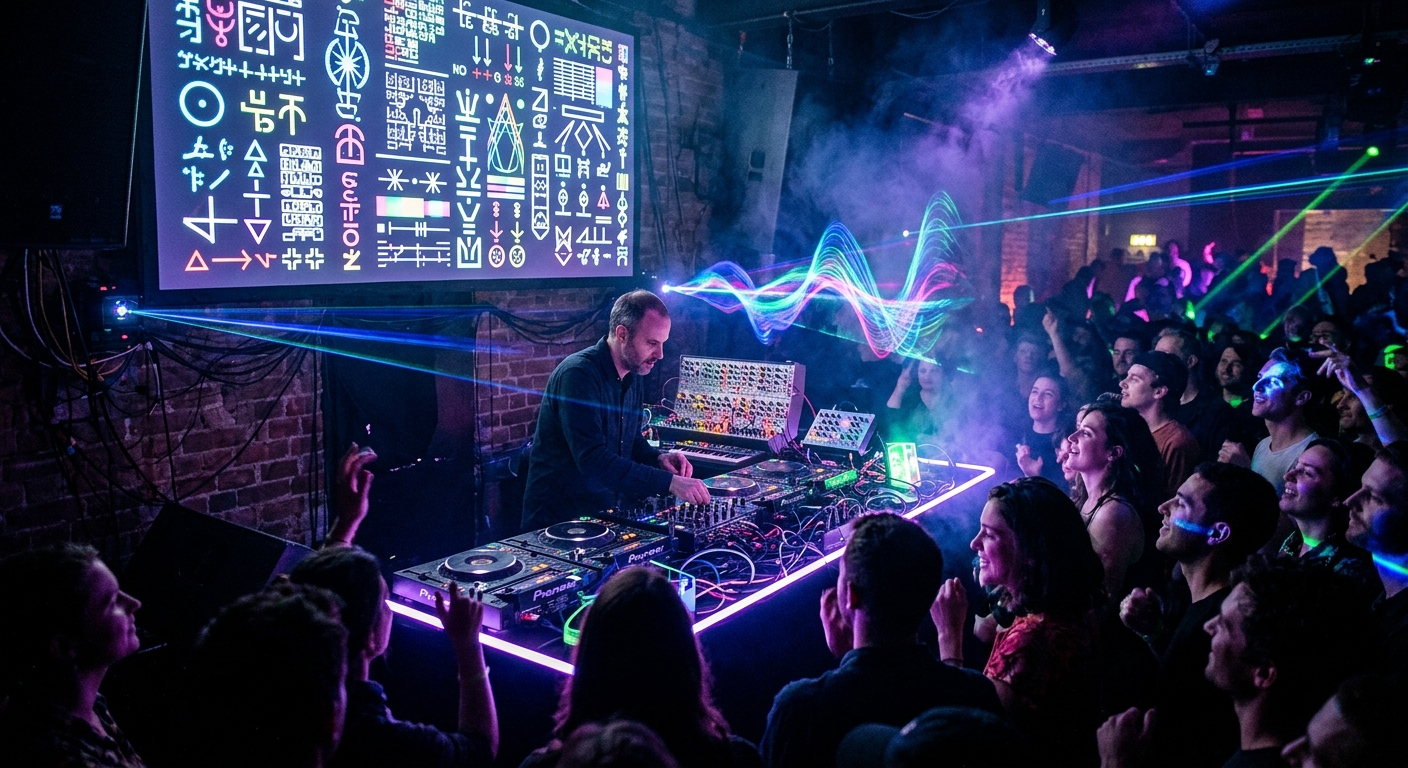
In addition to his live shows, Hebden’s work has intersected with visual art and experimental notation traditions. His unpronounceable glyph project, represented by a Wingdings
Legacy and Future Directions
Kieran Hebden’s glyph project, an enigmatic and experimental endeavor alongside his main Four Tet persona, has left a distinct mark on electronic music culture. Known for its brisk tempos and high energy, the project showcases some of Hebden’s most fully realized productions, blurring the lines between dance music and avant-garde experimentation. By deliberately subverting conventional track identification methods—such as obscuring record labels and utilizing unpronounceable glyphs—Hebden has challenged DJ culture’s norms and injected a playful secrecy into the practice of music selection and sharing.
The glyph project’s legacy lies in its successful fusion of artistic experimentation with dancefloor appeal, extending Hebden’s evolution from post-rock roots to complex digital rhythms that incorporate folk, jazz, and hip-hop influences. This multifaceted approach has resonated with audiences seeking innovative soundscapes that defy easy categorization, reinforcing Hebden’s reputation as a forward-thinking producer.
Looking ahead, the creative impulses driving the glyph project suggest a continued exploration of hybrid forms and experimental notation in music. Hebden’s ongoing work, which intersects with visual art and technology, indicates that future releases may further blur boundaries between sound, symbol, and performance. As electronic music culture continues to evolve, the glyph project stands as a compelling example of how artists can innovate not only through sound but also through the visual and conceptual presentation of their work.
The content is provided by Avery Redwood, 9 Minute Read