Summary
The legal and media dispute between former U.S. President Donald Trump and ABC News centers on the coverage of the Lincoln Memorial Reflecting Pool renovation project, which became a focal point of controversy beginning in 2026. Originally promoted by Trump’s administration as a swift and affordable cleanup, the project experienced significant delays and cost overruns, with expenses rising from an initial estimate of around $1 million to approximately $16 million. Despite employing advanced nanobubbler technology to address algae problems, the pool’s condition remained problematic, attracting critical media scrutiny, notably from ABC News.
Trump and his administration accused ABC News of biased and misleading reporting, alleging that the network omitted crucial context regarding prior administrations’ expenditures exceeding $100 million on the reflecting pool’s upkeep and falsely portrayed the project’s difficulties. The administration also suggested that damage to the pool resulted from vandalism, though conclusive evidence was not publicly substantiated. In response to ABC’s coverage, Trump initiated multiple defamation lawsuits against the network and specific journalists, including anchor George Stephanopoulos, challenging the accuracy and fairness of their reporting.
The ensuing legal battles highlight the complex intersection of media accountability, political communication, and First Amendment protections. Courts have grappled with issues such as the “actual malice” standard established in New York Times Co. v. Sullivan (1964), which sets a high bar for public figures to prove defamation, as well as the applicability of the fair report privilege in cases where context may have been omitted. While many legal experts view Trump’s claims as difficult to sustain under existing free speech doctrines, the lawsuits underscore broader tensions between the press and political figures and raise concerns about the chilling effects of litigation on journalistic practices.
ABC News maintains its commitment to editorial standards emphasizing accuracy, fairness, and thorough fact-checking, even as it faces intensified scrutiny and regulatory challenges stemming from this and other politically charged reporting. The network’s settlement of one lawsuit for $16 million and its public responses to legal and regulatory pressures reflect the evolving dynamics of media operations in a polarized environment where legal, political, and public relations considerations increasingly overlap. This ongoing conflict exemplifies the fraught relationship between legacy media organizations and political actors in the contemporary American media landscape.
Background
In 2026, extensive renovation efforts were undertaken to clean and restore the Lincoln Memorial Reflecting Pool, a project heavily promoted by then-President Donald Trump. Initially announced as a quick and cost-effective cleanup expected to cost around $1 million and be completed within a week, the effort extended over several months and escalated in cost to approximately $16 million. Despite the use of innovative “advanced nanobubbler technology” to combat persistent algae problems, the Reflecting Pool remained plagued by issues such as peeling blue liner coatings and algae-infused water, prompting concerns about the project’s success and management.
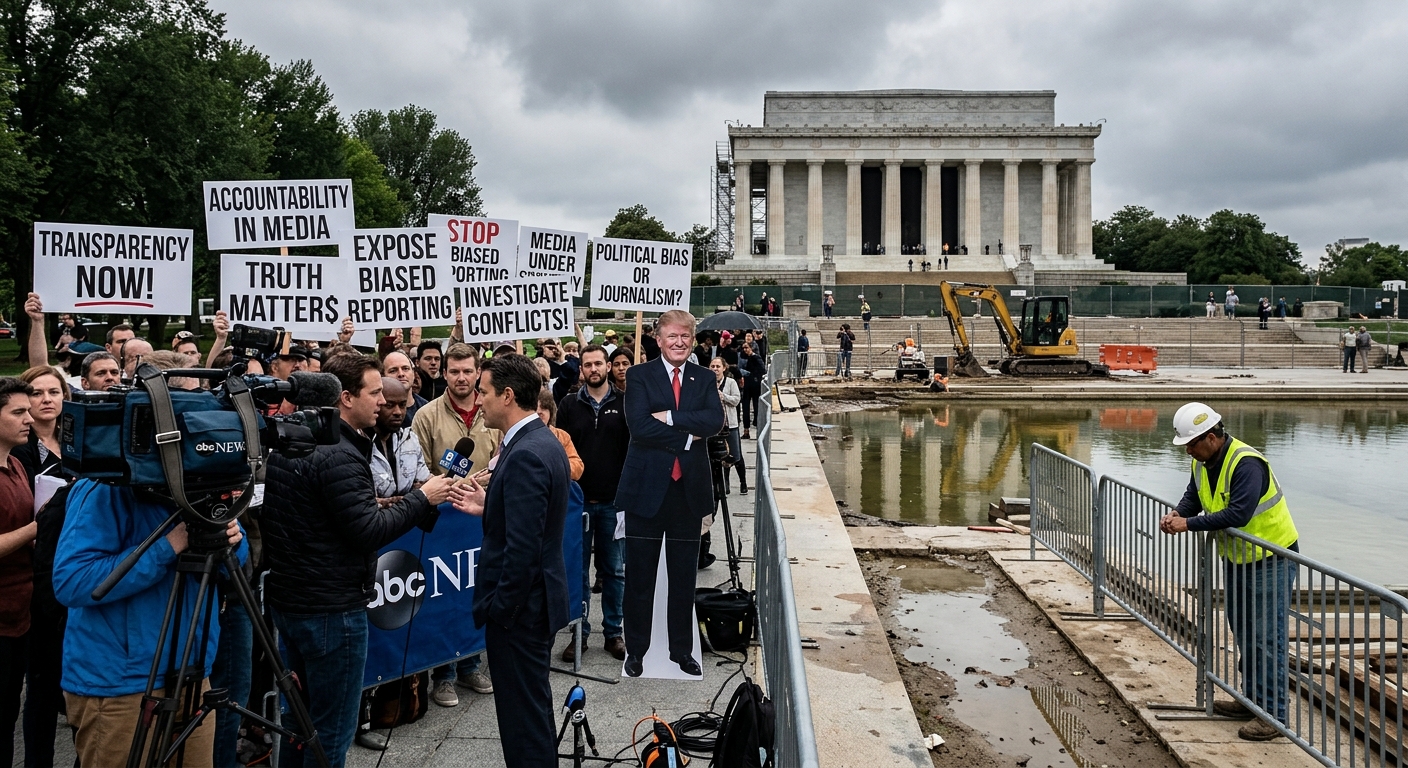
The renovation became a contentious topic in the media, with ABC News among the outlets providing extensive coverage that included critical assessments of the project’s delays, cost overruns, and visible deterioration after cosmetic updates. This coverage drew sharp criticism from President Trump and his administration, who alleged that ABC News had engaged in false reporting. Trump accused the network of unfairly focusing on negative aspects of the renovation while failing to disclose that previous administrations, including those of Barack Obama and Joe Biden, had spent over $100 million on the Reflecting Pool without success. He also claimed that the damage observed was due to vandalism, citing reports of a “350-foot slit” cut with a box cutter and multiple police reports filed, though concrete evidence for intentional damage was not publicly provided.
The administration’s frustration with media coverage extended beyond the reflecting pool story, with President Trump preparing lawsuits against ABC News for what he described as biased and inaccurate reporting. These tensions reflect broader disputes between the Trump administration and mainstream media outlets, highlighting issues of journalistic standards, perceived political bias, and the role of fact-checking in political discourse. ABC News maintains a reputation for adherence to established journalistic principles, including accuracy and fairness, though its editorial choices and framing can influence public perceptions of political leanings. The ongoing conflict over the reflecting pool story thus exemplifies the complex interactions between political figures and media organizations in the contemporary information environment.
Legal Actions
Former U.S. President Donald Trump has initiated multiple legal actions targeting ABC News over what he alleges to be false and defamatory reporting concerning his administration’s handling of the Lincoln Memorial Reflecting Pool in Washington, D.C.. Trump publicly declared his intention to sue ABC, accusing the network of omitting context about prior administrations’ expenditures on the pool and characterizing their coverage as misleading and politically motivated. Specifically, Trump contended that ABC failed to report significant renovation spending by the Obama and Biden administrations, which he claimed amounted to over $100 million and resulted in a dysfunctional reflecting pool, contrasting this with his own administration’s $16 million investment.
Following ABC’s reporting that a federal contract for repainting the reflecting pool escalated to $14.65 million—surpassing the original estimate by over $4 million—the dispute intensified, culminating in Trump’s lawsuits alleging libel and false reporting. A federal judge permitted Trump to pursue a defamation claim against ABC News, rejecting the network’s motion to dismiss the case and signaling that discovery could proceed.
ABC News and journalist George Stephanopoulos, whom Trump also sued over related coverage, defended their reporting by invoking Florida’s fair report privilege, which protects accurate summaries of official proceedings and information received from government officials. They further argued that Stephanopoulos’s on-air comments were “substantially true” and that Trump’s claims had been previously litigated. However, the court found that while the fair report privilege shields media outlets from strict technical precision requirements, it does not protect reports where the omission of key context renders the information misleading.
These lawsuits come amid a broader pattern of legal actions initiated by Trump against news organizations, including CBS News and others, targeting coverage he deems unfavorable or deceptive. Legal experts note that although many of Trump’s defamation claims face significant hurdles under the First Amendment—especially given the “actual malice” standard established in New York Times Co. v. Sullivan (1964)—the suits have effectively applied pressure on the press and may encourage additional litigation. The “actual malice” standard requires public figures like Trump to prove that false statements were made knowingly or with reckless disregard for the truth, a high bar that has historically protected media defendants but has not entirely precluded potentially legitimate claims from proceeding to discovery.
Legal Context and Defenses
The legal framework surrounding defamation claims involving public figures, such as former President Donald Trump, is heavily influenced by the Supreme Court’s landmark decision in New York Times Co. v. Sullivan (1964). This case established the “actual malice” standard, which requires public officials or public figures to prove that a defamatory statement was made with knowledge of its falsity or with reckless disregard for the truth in order to recover damages. This standard protects robust and uninhibited debate on public issues, recognizing that criticism of government and public officials may include “vehement, caustic, and sometimes unpleasantly sharp attacks”.
In practice, this means that plaintiffs like Trump face a high burden of proof in defamation lawsuits against media organizations. They must demonstrate not only that false information was published but also that the publisher acted with actual malice — either knowing the information was false or entertaining serious doubts about its accuracy. First Amendment protections provide broad leeway to the press when reporting on powerful individuals, including presidents and president-elects, to prevent lawsuits that could stifle free expression.
Another important defense invoked in media-related lawsuits is the fair report privilege, which offers qualified protection to news organizations for substantially accurate reporting of official proceedings. However, courts have clarified that this privilege does not extend to reports that omit crucial context and thereby become misleading. For example, in Dershowitz v. Cable News Network, Inc. (2021), the privilege was rejected when a partial video clip was played in a manner that misrepresented an official proceeding. Similarly, a Florida federal judge highlighted that while the fair report privilege protects accurate information from government sources, it does not shield media when the omission of important context leads to misleading coverage.
The extension of the actual malice standard beyond libel claims has also shaped related areas of law. Cases such as Hustler Magazine v. Falwell (1988) and Milkovich v. Lorain Journal Co. (1990) have applied or clarified the standard in contexts including false light invasion of privacy and intentional infliction of emotional distress, affirming the need to balance free speech protections with individual reputations.
Despite the robust protections for the media, some lawsuits continue to challenge these legal boundaries. In Trump’s legal actions against ABC News, experts widely regard the claims as lacking merit due to the stringent actual malice standard and the broad First Amendment safeguards. Courts have dismissed or required amendment of complaints that are overly lengthy or fail to meet legal standards, underscoring the difficulties plaintiffs face in overcoming these constitutional protections. Nonetheless, the unfolding legal battles highlight ongoing tensions between free expression and accountability in media reporting.
Timeline of Key Events
In early 2024, ABC News published a report detailing the cost overruns associated with the repainting of the Lincoln Memorial Reflecting Pool, revealing that the price had escalated to $14.65 million, exceeding the original estimate by over $4 million. This report sparked immediate backlash from then-President Donald Trump, who accused ABC of “false reporting” and preparing lawsuits against the broadcaster for their coverage of the Reflecting Pool repairs.
Subsequently, Trump filed a defamation lawsuit specifically targeting statements made by ABC anchor George Stephanopoulos during an interview on March 10, 2024. Stephanopoulos had repeatedly asserted that Trump had been found “liable for rape,” a claim based on a civil case in which a jury determined Trump was liable for “sexual abuse” under New York law. ABC News later agreed to settle this lawsuit for $16 million, accompanied by an editor’s note expressing regret for the inaccurate statements made by Stephanopoulos.
The settlement stipulated that ABC News would append an editor’s note to the original online article from March 10, 2024, clarifying the network’s regret over the erroneous claims. This event marked a significant moment, as it was among the first major legal settlements arising from Trump’s recent escalated efforts to use the courts to challenge media coverage he deemed unfavorable.
Throughout this period, ABC News maintained its commitment to fact-checking and live verification, employing traditional methods and partnerships to ensure accuracy in its reporting, particularly regarding political coverage. However, the disputes highlighted ongoing tensions between legacy media outlets and political figures, particularly around perceptions of impartiality and media accountability.
As of mid-2024, the broadcaster was facing two Federal Communications Commission investigations, compounding the legal and regulatory pressures stemming from the contentious coverage and the subsequent lawsuits initiated by Trump. The lawsuit against ABC is part of a broader pattern of legal actions initiated by Trump targeting various media organizations, reflecting his intensified antagonism toward the press.
Public and Political Reactions
The public and political reactions to the ABC settlement and the broader context of lawsuits involving former President Trump reveal a complex interplay of free speech debates and media dynamics. Many commentators have pointed out a perceived contradiction among those celebrating the settlement: these individuals often argue that free speech is under attack and that the public should become more resilient to scrutiny, yet they support Trump’s numerous lawsuits against media outlets, which until recently had largely failed. This tension highlights the challenges in reconciling calls for robust public discourse with the strategic use of litigation to counter unfavorable coverage.
Media observers have noted that platforms like Meta reducing their reliance on third-party fact-checkers have shifted the responsibility for verifying public speech back to journalists and in-house verifiers. This transition has intensified scrutiny of when and how legacy media correct themselves, as partisan audiences frequently interpret corrections as political maneuvers rather than journalistic integrity. The ABC settlement is seen as emblematic of this heightened pressure on traditional news organizations.
Legal experts underscore the importance of the “actual malice” standard established in landmark cases such as New York Times v. Sullivan (1964), which protects free speech while allowing for correction of misinformation that is not spread with malicious intent. There is concern among defenders of free speech that weakening this standard could lead the United States toward a more authoritarian environment, underscoring the high stakes involved in media litigation.
The settlement has also drawn criticism from within the media industry. Media reporter Oliver Darcy suggested that ABC News’s capitulation may embolden Trump and his allies, who have indicated intentions to escalate their legal challenges against the press. He further attributed ultimate responsibility to senior executives, including Disney’s Bob Iger, reflecting unease about corporate leadership’s role in shaping responses to such lawsuits.
Additionally, the surge in lawsuits initiated by Trump against news organizations, previously dismissed by media lawyers as lacking merit, is now viewed as an effective tactic to harass and burden the press. First Amendment experts remain skeptical of the legal basis of these suits but acknowledge their potential chilling effect on journalism, with expectations of more cases emerging in the near future.
Against this backdrop, ABC’s own stance has shifted notably, with the company publicly criticizing regulatory efforts as having a “chilling effect” on free speech, particularly regarding political content. This marks a significant departure for the network and signals a broader reconsideration of how media entities navigate political pressures and legal risks.
ABC News’ Editorial Standards and Responses
ABC News maintains a commitment to professional journalistic standards that prioritize accuracy, verification, and fairness across all its fact-based content. This includes news, current affairs, documentaries, commentary, interviews, reviews, magazine-style programs, quiz shows, and online data presentations. The network’s editorial guidelines emphasize fact-checking and the use of multiple sources to ensure balanced and reliable reporting.
Part of ABC’s rigorous approach to accuracy involves specialized fact-checking units such as RMIT ABC Fact Check, which collaborates with external organizations like PolitiFact. These teams systematically evaluate political claims and public-interest statements, conducting thorough analyses of debates, speeches, and campaign assertions to provide documented and rated assessments of their veracity. This process reflects ABC’s ongoing dedication to transparency and accountability in its coverage.
Despite these standards, editorial decisions—such as story selection and the choice of guest experts—can influence perceptions of ABC News’ political leanings. The network aims to cater to a diverse audience by maintaining middle-ground reporting that avoids alienating viewers with extreme positions. Nonetheless, interpretations of fairness sometimes reflect prevailing cultural and ideological norms within the newsroom, subtly shaping the framing of political issues.
In response to criticisms and legal challenges, including those from former President Donald Trump who has threatened lawsuits over perceived false reporting, ABC News continues to uphold its editorial principles. These legal disputes highlight the tension between media organizations’ editorial independence and external pressures but have not deterred ABC from adhering to its established journalistic practices.
Implications and Impact
The ongoing legal confrontations between Donald Trump and media organizations, notably ABC News, have significant implications for journalistic practice and the broader media landscape. ABC News’ recent $16 million settlement in a defamation case brought by Trump marked a notable moment, signaling a shift in how such lawsuits are perceived within the industry and by legal experts. While First Amendment specialists generally regard Trump’s legal claims as lacking strong legal merit, the growing frequency and persistence of these lawsuits have been recognized as effective tools for press harassment, potentially deterring investigative journalism and increasing the operational risks for news organizations.
These developments occur amid evolving editorial standards and challenges in maintaining impartiality and accuracy. For instance, ABC News faces criticism regarding the omission of relevant perspectives and the complexities of balancing evidence weight, sometimes resulting in breaches of editorial impartiality standards. The organization’s internal editorial choices, including story selection and the framing of political issues, influence perceptions of bias and fairness, often reflecting broader cultural and ideological norms within newsrooms. Furthermore, the reduction in third-party fact-checking by platforms like Meta has heightened the role of journalists and in-house verifiers in real-time fact-checking, increasing scrutiny on editorial decisions and corrections, which are increasingly
The content is provided by Harper Eastwood, 9 Minute Read